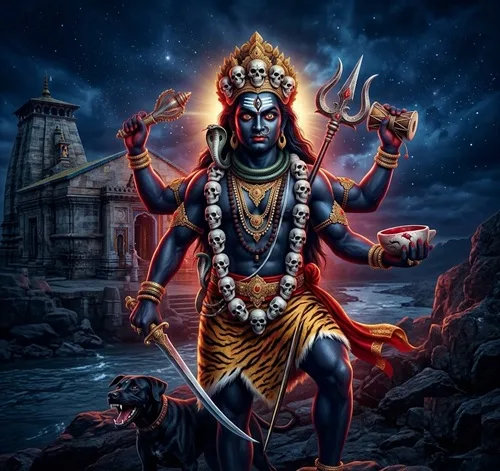
Bhairava or Bhairavnath is a fierce and furious form of Lord Shiva, who is considered extremely powerful and fearsome. Bhairava is said to be the god of destruction and annihilation, who destroys injustice and wrongdoing. He symbolizes Shiva's intense anger and ferocity, and is therefore considered the lord of fear and resentment. Bhairava's worship is considered especially important in Tantric Sadhana, where his worship can free the practitioner from evils and ignorance.
Origin of Bhairava
The story related to the origin of Bhairava is found in Shiva Purana. According to the story, once Brahma Ji insulted Lord Shiva, considering himself the supreme god of creation. On this, Shiva assumed his fierce form and manifested Bhairava from his third eye. Bhairava cut off one of Brahma's heads to end his ego, as Brahma boasted of having five heads. After this incident, Lord Bhairava also came to be known as "Kapaleshwar" because he held the head of Brahma.
Types of Bhairava
There are mainly eight forms of Bhairava, which are called Ashta Bhairava. All these forms symbolize different elements and powers of creation.
1. Asitang Bhairava 2. Rudra Bhairava 3. Chanda Bhairava 4. Krodha Bhairava 5. Unmatta Bhairava 6. Kapal Bhairava 7. Bhishan Bhairava 8. Sanhar BhairavaHis different forms are worshipped for tantric sadhana and protection. Each Bhairav has different mantras, worship methods and effects.
Form of Bhairav
The form of Bhairav is very fierce and terrifying, which shows his destructive form:
Shava Vahana: Bhairav's vehicle is dog, which is a symbol of death and crematorium.
Trishul and Khadga: Bhairav has trident and sword in his hands, which are the symbols of his power and justice.
Kapal: Bhairav holds Kapal (skull) in his hands, which is a symbol of destruction and cycle of life-death.
Bhasm Vibhushit: His body is smeared with ash, which shows his relation with crematorium and death.
Kaal Bhairava
Kaal Bhairava is the most famous and powerful form of Bhairava. He is considered the lord of Kaal (time), and this form of his is believed to represent the cycle of life and death. Kaal Bhairava is worshipped to get free from the shackles of time and time.
The Kaal Bhairava Temple located in Varanasi is very famous, where he is worshipped especially. It is believed that the king of Kashi is Kaal Bhairava himself and no person can leave Kashi without his permission.
Bhairava Puja and Tantric Sadhana
The worship of Bhairava is considered especially important in Tantra Sadhana. Tantric practitioners worship Bhairava to receive his blessings and power. It is believed that worshiping Bhairava liberates one from fear, ignorance, and evil forces. Dogs are fed during the worship of Bhairava as they are considered to be Bhairava's vehicle.Bhairav Ashtami
Bhairav Ashtami is a festival dedicated to Lord Bhairava, which is celebrated on the Ashtami of Krishna Paksha in the month of Margashirsha. It is also called Kaal Bhairava Jayanti, and on this day devotees perform special worship, fasting, and sadhna of Bhairava.
Bhairav symbolizes the fierce form of Shiva, who not only kills but also liberates the seeker from evils and demonic powers. He is especially worshipped in Tantra Sadhana and is considered to protect against negative forces. The form of Kaal Bhairava symbolizes victory over time and death, and worshipping him gives one indomitable strength and courage.