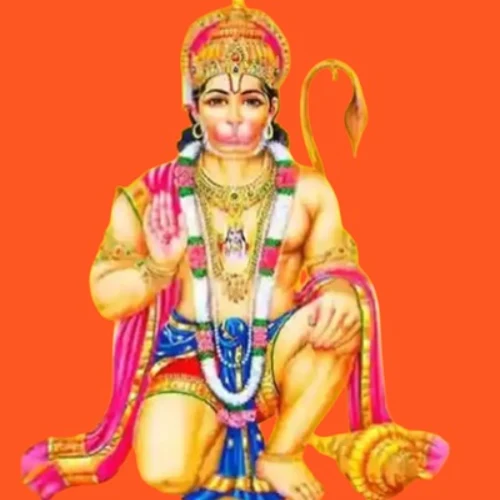
Tuesday fast is dedicated to Lord Hanuman and Mars planet. By observing this fast, a person gets happiness, peace, prosperity, and freedom from diseases in life. Also, this fast provides courage and energy.
Tuesday fast story
Vyasa said: Once, eighty thousand sages gathered at the sacred place of Naimisharanya and asked Shri Suta, the knower of the Puranas: "O great sage! You have narrated to us the stories of many Puranas. Now, please tell us about a vow and a story by observing which one can obtain children and be freed from the fear of disease, sorrow, fire, and all kinds of suffering, because in Kali Yuga, the lifespan of all beings is very short. If they are constantly afflicted by disease and anxiety, how will they be able to focus their minds on the feet of Lord Hari?"
Shri Suta replied: "O sages! You have asked a very excellent question for the welfare of the world. Once, Yudhishthira asked Lord Krishna the same question for the welfare of mankind. I will now narrate to you the conversation between Lord Krishna and Yudhishthira; listen attentively.
Once, Lord Krishna was seated in the assembly of the Pandavas. Then Yudhishthira asked Lord Krishna, "O Lord, Nandnandan, Govinda! You have narrated many stories to me. Today, please graciously tell me about a vow or a story, by observing which a person is freed from the fear of disease and anxiety, and is blessed with a son. O Lord, life without a son is meaningless; without a son, a person goes to hell; without a son, a person cannot be freed from the debt to his ancestors, nor can he be saved from the hell called Punnama. Therefore, please tell me about a vow that grants a son."
Lord Krishna replied, "O King! I will narrate an ancient story; listen to it carefully."
There was a city called Kundalpur, and in it lived a Brahmin named Nanda. By the grace of God, he had everything, yet he was unhappy. The reason for this was that his wife, Sunanda, had no children. Sunanda was a devoted wife and worshipped Lord Hanuman with great devotion. She observed a fast on Tuesdays, and after preparing food and offering it to Lord Hanuman, she would then eat. One Tuesday, due to the abundance of household chores, the Brahmin's wife was unable to offer food to Lord Hanuman. This caused her great sorrow. She ate nothing and vowed in her heart that she would only partake of food and water after offering it to Lord Hanuman the following Tuesday.
The Brahmin woman Sunanda prepared food every day, respectfully fed her husband, but did not eat herself, and silently worshipped Lord Hanuman. Six days passed in this way, and the Brahmin woman Sunanda remained hungry and thirsty, without food or water, as per her vow. The following Tuesday, Sunanda fainted and collapsed early in the morning.
Influenced by the boundless devotion of the Brahmin woman Sunanda, Lord Hanuman was greatly pleased and appeared before her, saying, "Sunanda! I am very pleased with your devotion. Arise and ask for a boon."
Overwhelmed with joy at seeing her beloved Lord Hanuman, Sunanda fell at his feet and said, "O Lord, I have no children. Please bless me with the boon of having a child. I would be eternally grateful."
Lord Hanuman replied, "Your wish will be fulfilled. You will have a daughter, and her eight limbs will daily yield gold." Saying this, Lord Hanuman disappeared. The Brahmin woman Sunanda was overjoyed and told her husband all the news. The Brahmin, hearing about the boon of a daughter, was somewhat saddened, but when he heard about the gold, he was very happy. He thought that with such a daughter, his poverty would also end.
By the grace of Lord Hanuman, the Brahmin woman became pregnant, and in the tenth month, she gave birth to a very beautiful daughter. This child grew up in her father's house just like the waxing moon. On the tenth day, the Brahmin performed the naming ceremony for the girl. His family priest named the girl Ratnavali, because this girl provided gold. This girl had observed the vow of Mangaldev (Mars) with great devotion in her previous life.
Ratnavali's eight limbs yielded a large amount of gold, and with that gold, the Brahmin Nanda became very wealthy. Now the Brahmin woman also became very proud. Time passed, and Ratnavali was now ten years old. One day, when the Brahmin Nanda was in a cheerful mood, Sunanda said to her husband, "My daughter Ratnavali is now of marriageable age, so please find a handsome and suitable groom and arrange her marriage." Hearing this, the Brahmin said, "Ratnavali is still very young." Then the Brahmin woman replied, "The scriptures state that a girl is called Gauri at eight years, Rohini at nine years, and Kanya at ten years, after which she becomes menstruating." "By donating to Gauri, one attains the netherworld; by donating to Rohini, one attains Vaikuntha; and by donating to a maiden, one attains happiness in Indraloka. But, O my husband! If a donation is made to a menstruating woman, one attains a terrible hell.
The Brahmin replied, "Ratnavali is only ten years old, and I have arranged marriages for girls as old as sixteen. What's the hurry?" Then the Brahmin's wife, Sunanda, said, "It seems you have become too greedy. The scriptures say that if parents and an elder brother see a menstruating girl, they will surely go to hell."
Then the Brahmin said, "Very well, tomorrow I will certainly send my messenger to search for a suitable groom." The next day, the Brahmin called his messenger and instructed him to find a groom as handsome as his daughter. The messenger, receiving his master's orders, set out. In the city of Pampai, he saw a handsome boy. This boy was a virtuous son of a Brahmin family, and his name was Someshwar. The messenger gave his master a complete description of this handsome and virtuous Brahmin boy. The Brahmin and Nanda also liked Someshwar, and then, at an auspicious time, they performed the ritual of giving away the daughter in marriage, and the Brahmin and his wife were satisfied.
However! Greed had taken hold of the Brahmin's mind. He had given his daughter away in marriage, but he was also very unhappy. He thought that Ratnavali would now leave, and the gold he used to receive from her would no longer be available. Some of the wealth he had was spent on her marriage, and what remained would also be gone in a few days. I have made a big mistake by marrying her off. Now, if only there was some way that Ratnavali could remain in my house and not go to her in-laws' house. The demon of greed was increasingly clouding the Brahmin's mind. Tossing and turning restlessly on his bed all night, he made a very cruel decision. He thought that when Someshwar, along with Ratnavali, would be on his way home, he would hide along the road, kill Someshwar, and take his daughter back to his own house. This way, he would continue to receive gold regularly, and no one in society would be able to blame him.
When morning came, Nanda and Sunanda bid farewell to their son-in-law and daughter, giving them a large amount of wealth. Someshwar, along with his wife Ratnavali, then set off from his in-laws' house towards his own home.
The Brahmin Nanda, overcome by greed, had lost his senses. He no longer considered right or wrong. To carry out his terrible and cruel plan, he sent his messenger to kill his son-in-law on the way, so that the gold he received from Ratnavali would continue to come to him and he would never be poor. The Brahmin's messenger, obeying his master's command, killed his son-in-law, Someshwar, on the way. Upon receiving the news, Brahmin Nanda arrived at the spot and said to his weeping daughter, Ratnavali, "O daughter! Robbers have killed your husband on the way. No one has any control over God's will. Now come home, and live the rest of your life there. Whatever is destined will happen."
Ratnavali was deeply saddened by her husband's untimely death. Weeping and lamenting, she said to her father, "O father! In this world, a woman whose husband is dead has no reason to live. I will burn my body with my husband and, by becoming a Sati, I will make this life, the name of my parents, and the honor of my in-laws meaningful."
Brahmin Nanda was very saddened to hear his daughter Ratnavali's words. He began to think, "I have needlessly burdened myself with the sin of killing my son-in-law. Ratnavali is even ready to give up her life for him. I am ruined on both counts. I will not get the wealth now, and as a result of the sin of killing my son-in-law, I will also have to suffer the torments of Yama." Thinking this, he became very dejected.
Someshwar's pyre was prepared. Ratnavali, wishing to become a Sati, sat on the pyre with her husband's head in her lap. As soon as Someshwar's pyre was lit, Mangal Dev (the god of Mars) appeared there happily and said, "O Ratnavali! I am very pleased with your devotion to your husband. Ask for a boon." Ratnavali asked for her husband's life. Then Mangal Dev said, "Ratnavali! Your husband is immortal." He will also be a great scholar. And besides this, ask for whatever other boon you desire.
Then Ratnavali said, "O Lord of the planets! If you are pleased with me, then grant me this boon: that any person who worships you on Tuesday morning with red flowers and red sandalwood, and remembers you, shall be free from disease and illness, shall never be separated from their loved ones, and shall have no fear of snakes, fire, or enemies. And any woman who observes the Tuesday fast shall never become a widow.
Mangaldev, saying "So be it," disappeared.
Someshwar was brought back to life by the grace of Mangaldev. Ratnavali was overjoyed to have her husband back and, by observing the vow of Mangaldev every Tuesday, and with the blessings of Vratraj and Mangaldev, she enjoyed happiness and prosperity in this world and finally went to heaven with her husband.
॥Thus concludes the story of the Tuesday Vrat॥
Vrat Vidhi
- Take bath in the morning and wear clean clothes.
- Light a lamp in front of the idol or picture of Lord Hanuman.
- Offer red flowers, jaggery and gram as prasad.
- Recite Sunderkand or Hanuman Chalisa.
- Eat fruits throughout the day and keep the mind calm.
- In the evening, perform the aarti of Lord Hanuman and listen to the story of the fast.
- End the fast the next day by feeding a Brahmin.
Tuesday fast brings blessings of Lord Hanuman and brings prosperity, peace and strength in life.