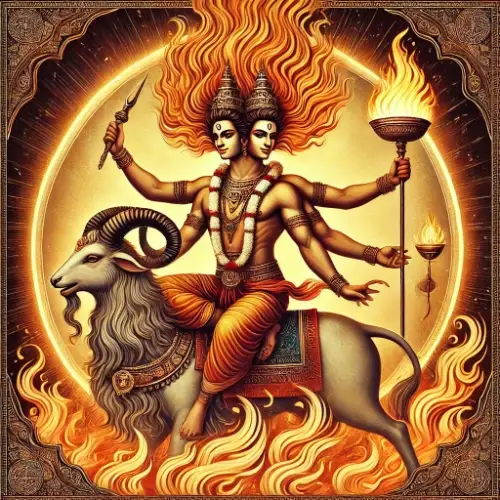
Agni Dev is revered as the deity of fire in Hinduism. Fire holds a paramount place in the Vedic tradition, and numerous hymns dedicated to Agni are found in the Rigveda. Agni is also regarded as the medium that conveys messages and sacrificial offerings between gods and humans.
Fire plays a significant role in Hindu religious traditions, particularly in rituals such as Yajna, Havan, and various sacraments (Samskaras). Agni is considered a symbol of purity, light, energy, and transformation.
Vedic Significance of Agni Dev
Agni holds a prominent position among the Vedic deities. The very first hymn of the Rigveda begins with the praise of Agni. In the Vedic tradition, Agni is regarded as the priest of the Yajna and the carrier of oblations to the gods.
During a Yajna, when ghee, grains, medicinal herbs, and other prescribed materials are offered into the fire, religious belief holds that Agni conveys these offerings to the gods.
For this reason, Agni is also perceived as a bridge between gods and humans.
Form of Agni Dev
Agni Dev is described in various forms across Vedic and Puranic traditions. He is generally depicted as a radiant deity possessing a red or golden aura.
A ram is mentioned as the vehicle (Vahana) of Agni Dev. His multiple hands are often shown holding symbols and vessels associated with fire.
Religious texts also describe Agni as having multiple tongues, which are considered symbols of the various powers of fire that accept the sacrificial offerings of the Yajna.
Agni Dev and Yajna
In Hinduism, there is a profound connection between Agni (the Fire God) and Yajna (sacrificial ritual). The fire of the Yajna is regarded as a sacred medium into which offerings are made accompanied by the chanting of mantras.
The presence of fire in Yajna and Havan rituals is considered religiously vital. Even during the wedding ceremony, the bride and groom take the seven circumambulations (Saptapadi) with fire as their witness.
Thus, fire is not merely an element of worship but is also revered as a divine witness in numerous Hindu rituals and sacraments.
Agni Dev and Marriage
Fire holds special significance in Hindu marriage traditions. During the wedding ceremony, the bride and groom circle the fire—or perform circumambulations in its presence—in accordance with established Vedic traditions.
The practice of invoking fire as a witness signifies that the marital vow is accepted as a sacred and public religious pledge.
Mythological Tales of Agni Dev
Numerous stories concerning Agni Dev are found in Vedic and Puranic literature. One famous legend recounts how Agni went into hiding and was subsequently sought out by the gods.
Agni is regarded as a deity capable of manifesting in various places and conveying offerings to the gods through the *Yajna* (sacrificial fire ritual). Different texts and traditions offer varied accounts regarding Agni's origin and nature.
References to Agni Dev's Family
Puranic traditions identify Goddess Svaha as the consort of Agni Dev. The custom of chanting the word 'Svaha' while making offerings during a *Yajna* is believed to stem from this association.
Various Puranas and religious texts also provide details about Agni Dev's sons and his different manifestations.
Symbolic Significance of Agni Dev
Agni is not merely a symbol of physical fire; in Hindu philosophy and religious tradition, the element holds multiple spiritual meanings.
Agni is a symbol of light — it dispels darkness.
Agni is a symbol of purification — it is associated with removing impurity and bestowing purity.
Agni is a symbol of energy — the significance of energy in life and nature is illustrated through Agni.
Agni is a symbol of transformation — it transforms matter from one form to another.
For these reasons, Agni is considered extremely sacred in Hindu religious traditions.
Worship of Agni Dev
Agni Dev is worshipped primarily through rituals such as *Yajna* and *Havan*.
In general religious tradition, by lighting a fire, prescribed material is offered along with mantras.In special rituals, Vedic mantras are chanted and the method of offering is done as per tradition. For big yagyas or special Vedic rituals, it is considered appropriate to perform puja under the guidance of a qualified Acharya.
Mantra of Agni Dev
A famous Vedic mantra related to Agni Dev is taken from the first mantra of Rigveda:
Om Agnimilee Purohitam Yagyasya Devmritvijam.
Hotaram Ratnadhatam॥
This is the first mantra of Rigveda. And praises Agni Dev.
Agni Dev and the Panchamahabhutas
In Hindu philosophy, the five primary elements of nature are known as the Panchamahabhutas:
Earth (Prithvi)
Water (Jal)
Fire (Agni)
Air (Vayu)
Space/Ether (Akasha)
Among these, fire is the third element. It is associated with energy, heat, and light.
The concept of Agni is also significant in Ayurveda and Indian philosophy. Specifically, digestive power is referred to as Jatharagni.
The Connection Between Agni and the Sun
In Indian religious tradition, both Agni and the Sun are associated with light and energy. The Sun is considered the primary source of celestial light and energy, whereas fire is the direct manifestation of light and heat on Earth.
Vedic literature mentions symbolic connections between the Sun and Agni.
The Religious Message of Agni Dev
The nature of Agni Dev conveys a message of light, energy, purity, and transformation to humanity. Just as fire dispels darkness, knowledge is believed to dispel the darkness of ignorance.
The fire of the Yajna (sacrificial ritual) also signifies that a human being can renounce their desires and ego to dedicate themselves to a higher purpose.
Agni Dev is one of the principal deities in Hinduism, particularly within the Vedic tradition. Agni is regarded as the medium of the Yajna, the carrier of offerings to the gods, a symbol of purity and light, and a witness to religious rituals.
The special significance of Agni is evident everywhere—from the very first mantra of the Rigveda to various rituals such as weddings, Havan, and Yajna. Worshipping Agni Dev inspires us towards light, energy, purity, sacrifice, and positive transformation.