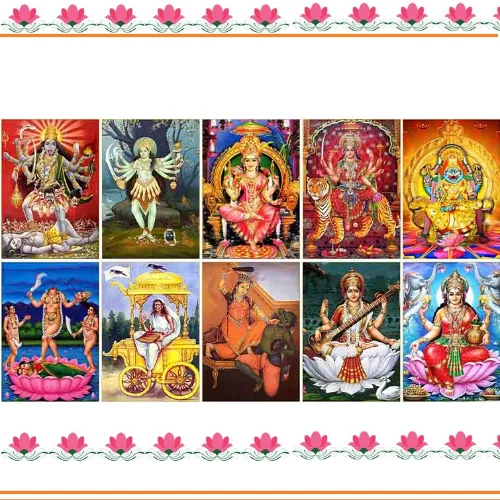
Mahavidya refers to a group of ten principal forms of the Goddess Shakti within the Shakta tradition of Hinduism. Collectively, they are known as the Dasha Mahavidya. 'Maha' signifies 'great,' and 'Vidya' denotes 'knowledge' or 'divine realization.' Thus, the Mahavidyas represent divine powers associated with various aspects of life, consciousness, creation, transformation, and spiritual wisdom.
The tradition of the Dasha Mahavidya is particularly associated with Tantric and Shakta spiritual practices (*sadhana*). The forms of these ten goddesses vary significantly—some are fierce, others gentle; some symbolize knowledge, while others represent prosperity and abundance.
Names of the Ten Mahavidyas
The names of the Dasha Mahavidyas are generally listed as follows:
Maa Kali
Maa Tara
Maa Tripura Sundari
Maa Bhuvaneshwari
Maa Tripura Bhairavi
Maa Chhinnamasta
Maa Dhumavati
Maa Bagalamukhi
Maa Matangi
Maa Kamala
Each Mahavidya embodies a distinct spiritual and symbolic aspect of the Goddess Shakti.
1. Maa Kali
Maa Kali is considered the first among the Dasha Mahavidyas. Her form is associated with the power of time, transformation, and destruction. The name 'Kali' itself is linked to 'Kala' (Time).
Maa Kali's fierce form symbolizes the destruction of ego, ignorance, and negative forces. In the Shakta tradition, she is worshipped as a supremely potent manifestation of the Ultimate Power.
2. Maa Tara
Maa Tara is considered the second principal form among the Dashamahavidyas. The word 'Tara' is associated with the act of ferrying across or delivering one to salvation.
In religious traditions, Maa Tara is worshipped as the Goddess who protects against adversity and provides knowledge and spiritual guidance. She is also associated with compassion, protection, and spiritual wisdom.
3. Maa Tripura Sundari
Maa Tripura Sundari is also known as Shodashi and Lalita Tripura Sundari. She is regarded as the Goddess of beauty, bliss, love, and divine consciousness.
The worship of Tripura Sundari holds special significance in the Sri Vidya tradition. She occupies a central place in Sri Chakra and Sri Vidya spiritual practices.
4. Maa Bhuvaneshwari
Maa Bhuvaneshwari is viewed as the presiding power of the entire universe. The name 'Bhuvaneshwari' signifies the 'Mistress of the Worlds'—that is, the Goddess of all realms of existence.
Her form symbolizes vastness, creation, and cosmic consciousness. In the Shakta tradition, she is worshipped as the fundamental power sustaining the world.
5. Maa Tripura Bhairavi
Maa Tripura Bhairavi is considered a fierce and powerful form among the Dashamahavidyas. She is associated with penance, discipline, power, and spiritual practice.
The form of Bhairavi inspires the spiritual seeker to conquer inner fears, weaknesses, and negative tendencies.
6. Maa Chhinnamasta
The form of Maa Chhinnamasta is considered highly mysterious and symbolic among the Dashamahavidyas.
Their form embodies profound spiritual meanings, such as inner strength, self-sacrifice, vital energy, and the transcendence of the ego. Their form conveys the message that rising above attachment and the ego is essential for spiritual growth.7. Maa Dhumavati
Maa Dhumavati represents a unique form among the Dashamahavidyas. She is associated with detachment, emptiness, the harsh realities of life, and spiritual discernment.
Her form differs from the conventional depictions of goddesses. Dhumavati signifies that sorrow, deprivation, and change can also be integral parts of the spiritual experience.
8. Maa Bagalamukhi
Maa Bagalamukhi is revered as the goddess associated with power, control, and protection against adversaries. She has a special affinity for the color yellow; hence, she is also known as Pitambara Devi.
According to religious belief, Maa Bagalamukhi is worshipped to gain control over speech and negative forces, as well as for protection against obstacles.
9. Maa Matangi
Maa Matangi is regarded as the goddess of knowledge, arts, music, speech, and creative expression. She holds a significant place in the Tantric tradition.
As she is associated with speech and wisdom, the worship of Maa Matangi is linked to the power of creativity and expression.
10. Maa Kamala
Maa Kamala is considered the tenth of the Dashamahavidyas. Her form is associated with the lotus, beauty, prosperity, and auspiciousness.
Maa Kamala is viewed as a benevolent and prosperity-bestowing power, much like Goddess Lakshmi.
The lotus is a significant symbol in her iconography, representing purity and spiritual advancement.Spiritual Significance of the Dashamahavidyas
The ten Mahavidyas are not viewed merely as ten distinct forms of the Goddess; rather, they are considered symbols of different dimensions of the singular Adi Shakti (Primal Energy).
There is a tradition of understanding various aspects of life through them:
Kali — Time, transformation, and the destruction of the ego
Tara — Protection and guidance
Tripura Sundari — Beauty, bliss, and divine consciousness
Bhuvaneshvari — Creation and cosmic expanse
Bhairavi — Asceticism and power
Chhinnamasta — Sacrifice and self-realization
Dhumavati — Detachment and discernment
Bagalamukhi — Control and protection against obstacles
Matangi — Speech, art, and knowledge
Kamala — Prosperity and auspiciousness
In this light, the Dashamahavidyas symbolically represent various dimensions of life, such as creation, preservation, transformation, knowledge, power, detachment, and prosperity.
The Legend of the Dashamahavidya
A famous legend regarding the origin of the Dashamahavidyas is associated with Lord Shiva and Mother Sati. According to religious tradition, when Mother Sati insisted on attending the *Yajna* (sacrificial ritual) organized by her father, Daksha, and Lord Shiva sought to dissuade her, she manifested various powerful forms.
Different traditions recount varying details regarding the number and sequence of these forms. In the Shakta tradition, these divine manifestations came to be revered as the Dashamahavidyas (the Ten Great Wisdom Goddesses).
This legend illustrates the concept of the Goddess's infinite power and her ability to manifest in myriad forms.
Dashamahavidya and Sadhana
The Sadhana (spiritual practice) of the Dashamahavidyas is a significant aspect of Shakta and Tantric traditions. The worship of these goddesses involves the use of mantras, meditation (Dhyana), sacred diagrams (Yantras), ritual worship (Puja), and specific spiritual practices.
However, certain forms of Mahavidya Sadhana are considered highly specialized and esoteric. It is traditionally advised that such practices be undertaken under the guidance of a qualified Guru.
Navaratri and the Mahavidyas
Navaratri is the principal festival dedicated to the worship of the Goddess Shakti. During this period, alongside the various forms of Mother Durga, the Mahavidyas are also worshipped within many Shakta traditions.
Devotees of Shakti, in particular, engage in meditation, mantra chanting, and the recitation of hymns (*Stutis*) dedicated to the forms of the Dashamahavidyas.
The Message of the Dashamahavidya
The most significant message of the Dashamahavidya tradition is that divine power is not confined to a single form. The Goddess may manifest fiercely to destroy unrighteousness (Adharma), bestow wisdom, grant prosperity, or lead the spiritual seeker toward detachment (Vairagya) and self-realization.
Thus, the ten Mahavidyas are regarded as spiritual pathways for understanding the various facets of life and consciousness.
The term 'Mahavidya'—specifically referring to the Dashamahavidya—denotes the collective group of the ten principal forms of the Goddess Shakti within the Shakta tradition of Hinduism.
From Maa Kali to Maa Kamala, each Mahavidya possesses a distinct form, symbolic significance, and religious importance. The worship of the Dashamahavidyas is associated with power, knowledge, courage, self-realization, detachment, prosperity, and spiritual advancement. All these forms are widely understood as various dimensions of the same supreme Divine Feminine power.