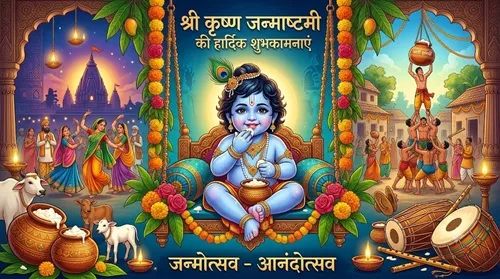
Krishna Janmashtami is one of the major festivals in Hinduism. It is celebrated to mark the birth anniversary of Lord Krishna. Lord Krishna is considered the eighth avatar (incarnation) of Lord Vishnu. On this day, devotees observe a fast, worship Lord Krishna, sing devotional songs (bhajans and kirtans), and celebrate the Lord's birth at midnight.
This festival conveys a message of devotion, righteousness (Dharma), love, and the triumph of truth. Janmashtami is celebrated with unique traditions across different regions of the country.
The Birth of Lord Krishna
According to religious scriptures, Lord Krishna was born in Mathura as the son of Devaki and Vasudeva. At that time, Kansa was the King of Mathura; a prophecy had foretold that he would be killed by Devaki's eighth child, a prospect that filled him with fear.
Kansa imprisoned Devaki and Vasudeva. Lord Krishna was born at midnight as their eighth child. Following the Lord's command, Vasudeva took Him to Gokul, where He was raised in the home of Nanda Baba and Mother Yashoda.
Lord Krishna later slew Kansa and played a pivotal role in establishing righteousness (Dharma).
Religious Significance of Janmashtami
Janmashtami celebrates the divine incarnation of Lord Krishna. Through His life and teachings, Krishna imparted messages regarding righteousness (Dharma), duty (Karma), devotion, and truth.
In the Shrimad Bhagavad Gita, Lord Krishna explained the significance of duty and righteousness. His famous message is—
“Karmanye-vadhikaraste Ma Phaleshu Kadachana.”
This means that a person has the right to perform their duty, but no right to the fruits thereof.
The festival of Janmashtami inspires devotees to maintain faith and devotion towards God while fulfilling their duties.
Observance of the Janmashtami Fast
On Janmashtami, devotees observe a fast according to their faith and capacity. Generally, the procedure for the fast may be as follows—
Wake up early in the morning, bathe, and wear clean clothes.
Clean the place of worship.
Worship the idol of Lord Krishna or the Bal Gopal (infant Krishna) form.
Remember Lord Krishna and chant His name throughout the day.
Observe the fast by consuming only fruits (phalahar) or according to your family tradition.
Prepare for the celebration of Lord Krishna's birth at night.
Perform the Abhishek (ceremonial bathing) and worship of Lord Krishna at midnight.
Offer Makhan-Mishri (butter and rock sugar), fruits, and other Naivedya (sacred food offerings) to the Lord.
Perform Aarti and sing Bhajans and Kirtans (devotional songs).
Break the fast (Paran) according to your tradition.
Note: The rules of the fast may vary across different sects and family traditions.
Janmashtami Worship Rituals
For the night-time worship, install an idol of Lord Krishna in His infant form. An Abhishek with Panchamrit (a mixture of five sacred ingredients) may be performed. Afterward, bathe the deity with pure water and dress Him in new clothes.
Offer sandalwood paste, flowers, Tulsi leaves, Makhan-Mishri, fruits, and sweets to the Lord. Then, light a lamp and chant mantras dedicated to Lord Krishna.
At midnight, celebrate the Lord's birth by blowing the conch shell and ringing bells, followed by performing the Aarti.
Lord Krishna's Favorite Offerings
On Janmashtami, Makhan (butter) and Mishri (rock sugar) are specially offered to Lord Krishna.
Additionally, milk, curd, ghee, fruits, sweets, and Panchamrit are also offered.Tulsi leaves hold special significance in the worship of Lord Shri Krishna and are included in the Naivedya (offering).
Shri Krishna Mantras for Janmashtami
The following mantras can be chanted during the worship of Lord Shri Krishna—
Om Krishnaya Namah.
Om Namo Bhagavate Vasudevaya.
Hare Krishna Hare Krishna, Krishna Krishna Hare Hare.
Hare Rama Hare Rama, Rama Rama Hare Hare.
Mantras should be chanted with devotion and concentration.
Dahi Handi on Janmashtami
The Dahi Handi event is organized in many regions on the day following Janmashtami. Commemorating the butter-stealing antics of Lord Shri Krishna's childhood, youths and children come together to break an earthen pot (handi) suspended at a height.
Great enthusiasm for Dahi Handi is witnessed in many states across India, including Maharashtra.
Tableaux and Bhajans on Janmashtami
On the occasion of Janmashtami, beautiful tableaux depicting scenes related to Lord Shri Krishna are arranged in temples and homes. Decorations depicting infant Krishna, Nanda Bhavan, Gokul, and scenes from Krishna's divine pastimes (Leela) are set up.
At night, the birth celebration is observed with bhajans (devotional songs), kirtans (congregational chanting), and traditional chants such as "Nand ke Anand Bhayo, Jai Kanhaiya Lal Ki" (Joy in the house of Nanda; hail to Lord Krishna).
What to do on Janmashtami?
Contemplate Lord Krishna and chant His holy name.
Worship Bal Gopal (infant Krishna) with devotion.
Offer Tulsi leaves.
Donate food or clothing to the needy.
Recite the Shrimad Bhagavad Gita.
Participate in bhajans and kirtans.
Celebrate the festival with love and harmony with your family.
What not to do on Janmashtami?
Do not observe a fast that is too rigorous for your physical capacity.
Do not harbor negative thoughts during worship.
Do not use impure ingredients in the Naivedya (food offering) made for the Lord.
Do not mock religious traditions.
Do not limit the festival merely to entertainment.
The Spiritual Message of Janmashtami
The life of Lord Shri Krishna conveys a message of love, righteous action (Karma), ethics, and duty (Dharma). He taught that one must uphold one's Dharma and fulfill one's duties even in difficult circumstances.
Janmashtami is not merely a celebration of Lord Shri Krishna's birth; it is also a festival that inspires us to embrace righteousness, truth, love, selfless action, and devotion in our lives.
Krishna Janmashtami is the sacred festival celebrating the birth of Lord Shri Krishna. On this day, devotees worship Him through fasting, prayers, chanting of mantras, singing of devotional songs (bhajans and kirtans), and the midnight birth celebration.
Celebrating Janmashtami with faith and devotion fosters a spiritual atmosphere and positive emotions within the family. Embracing Lord Shri Krishna's teachings in one's life embodies the true spirit of this festival.