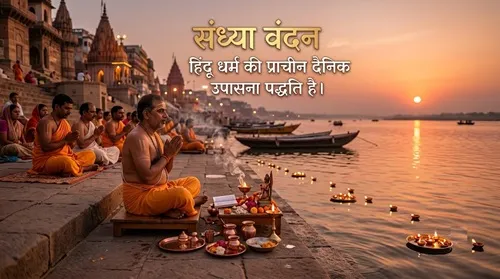
Sandhya Vandanam is an ancient daily worship practice in Hinduism. It involves meditation, the chanting of mantras, and prayer directed towards the Sun, Goddess Gayatri, and the Supreme Being at specific times: morning, midday, and evening. In the Vedic tradition, Sandhya Vandanam is considered a vital component of self-purification, discipline, and spiritual practice.
The purpose of Sandhya Vandanam is not merely to perform worship, but to remember the Divine while purifying one's mind, speech, and actions.
The term Sandhya Vandanam (Sanskrit: Sandhyāvandanam) literally means "worship performed at the time of *Sandhya*" (the juncture between day and night). It is an essential daily ritual in Hinduism that every *Dvija* (an individual who has undergone the *Upanayana* or sacred thread ceremony) is required to perform three times a day. This ritual combines the recitation of Vedic mantras with specific physical actions.
According to Maharshi Atri, "A person who does not perform Sandhya remains perpetually impure and does not reap the fruits of any auspicious deed." This statement underscores the mandatory nature of this ritual.
How often is Sandhya Vandanam performed?
Traditionally, Sandhya Vandanam is performed at three times—
Pratah Sandhya – Around sunrise
Madhyahnika Sandhya – Around midday
Sayam Sandhya – Around sunset
Among these, the morning (*Pratah*) and evening (*Sayam*) Sandhya are considered particularly significant. There may be variations in the procedures and mantras depending on the specific Vedic branch or tradition followed.
Preparation for Sandhya Vandanam
Before performing Sandhya Vandanam, bathe or cleanse yourself as much as possible and wear clean clothes. Spread a seat (*asana*) in a quiet and clean location. According to tradition, the direction is chosen based on the time of day.
For the ritual, one may generally place a vessel filled with water, a seating mat (*asana*), and the necessary worship materials.
General Procedure for Sandhya Vandana
First Step: Achamana (Ritual Sipping of Water)
Sandhya Vandana begins with *Achamana*.
Take water in the palm of your right hand.
Sip the water three times—reciting a mantra each time:
Om Keshavaya Svaha
Om Narayanaya Svaha
Om Madhavaya Svaha
The volume of water sipped should be roughly the size of a pea.
Second Step: Pranayama (Breath Control)
Pranayama is practiced to balance vital life energy (*Prana*).
Close both nostrils using your thumb and ring finger (or little finger).
Perform Pranayama three times.
Control your breath while chanting the mantras.
Third step: Sankalpam (Sankalpam)
In Sankalp, the seeker expresses his strong determination to offer evening prayers to the universe.
"Morning/Madhyanik/Evening Sandhyavandanam Aham Karishye" – This is the resolution mantra.
Through this, the seeker dedicates his work to God.
Fourth stage: Marjan (Marjanam)
Marjan is the process of purification.
In this stage the seeker prays for forgiveness for the unknowingly committed sins.
Purifies himself externally and internally by sprinkling water.
Intentionally committed. One gets the consequences of sins according to one's karma.
Fifth step: Tarpanam
In Tarpan, water is offered to various deities and planets.
Four Devtarpans are performed with water in the right hand between the fingers. Blessings and protection are obtained.
Sixth Step: Offering Arghya (Arghyapradanam)
Water Arghya is offered to the Sun God.
This is done especially in the morning and evening.
Seventh Step: Gayatri Invocation and Trust (Gayatri Ahvanam & Nyasa)
Gayatri Invocation – Gayatri Devi is invoked.
Nyaasa – Mental impositionof the deities on various parts of the body:
Karanyas – On the fingers of the hands
Anganyas – Parts of the body At the end of Anganyas, Digbandha (protection from eight directions) is recited
Eighth Step: Performing Mudras (Mudra Pradarshanam)
24 mudras are shown before Gayatri chanting and 8 mudras after chanting – a total of <32 mudras are shown. Are.
"Chaturvinshati Mudravai Gayatryam Supratisthitah. Itimudra Na Janati Gayatri Nishphalabhavet."
Meaning: Gayatri is well established in these 24 mudras. If these postures are not known then Gayatri Japa becomes futile.
Ninth Step: Gayatri Japa
This is the central and most important step of Sandhya Vandan.
Gayatri Mantra:
Om Bhurbhuvah Swah Tatsaviturvarenyam Bhargo Devasya. Dheemah dhiyo yo naah prachodayat॥
Number of chants (according to tradition):
| Evening | Number of chants |
|---|---|
| Morning | 108 times |
| Midday | 64 times |
| Evening | 32 Bar |
Types of chanting:
Vachik – clear pronunciation of the mantra
Upanshu – just move the lips, listen to yourself
Manas – completely mental chanting
Tenth step: Upasthan and dedication (Upasthanam & Samarpanam)
Tatsat Brahmarpanam AstuRight time for Sandhya Vandan
Sandhi period has been given special importance for Sandhya Vandan. In general—
Early evening:around sunrise
Midnight evening:At noon
Evening:around sunset
The exact time varies according to location and local sunrise-sunset. Therefore, it is more appropriate to determine the timing according to your local almanac (Panchang).
Mantras Required for Sandhya Vandana
| Mantra | Usage |
|---|---|
| Om Keshavaya Svaha | Achaman (Ritual sipping of water) |
| Om Narayanaya Svaha | Achaman |
| Om Madhavaya Svaha | Achaman |
| Gayatri Mantra | Japa (Chanting) |
| Sankalpa Mantra | Sankalpa (Solemn vow/intention) |
Significance of Sandhya Vandana
Sandhya Vandana is not merely a mechanical ritual; rather, it is a synthesis of Karma Yoga, Bhakti Yoga, and Jnana Yoga. Its key significances are as follows:
Self-purification – This ritual removes impurities accumulated through thoughts, words, and actions.
Spiritual energy – Sandhya-kaal (the juncture between day and night) is the time when *Prana* (life force) energy in nature is balanced.
Gayatri Sadhana – This is the supreme method for awakening the Gayatri Mantra, which connects individual consciousness with cosmic consciousness.
Divine grace – Regular Sandhya Vandana enables the seeker to receive divine grace.
Points to remember while performing Sandhya Vandana
Keep the place of worship clean and quiet.
Perform *Sandhya Vandana* at a regular time whenever possible.
Chant the mantras according to your tradition.
Chant the Gayatri Mantra with reverence and concentration.
Use water respectfully while offering Arghya (ritual offering) to the Sun.
If you wish to perform the complete ritual according to a specific Vedic branch, learn the procedure from a qualified Acharya (teacher).
Perform Sandhya Vandana not merely as a ritualistic formality, but as a spiritual practice for self-purification and remembrance of the Divine.
Benefits of Sandhya Vandana
According to religious and spiritual beliefs, Sandhya Vandana—
Helps the mind attain peace and concentration.
Fosters a sense of discipline and regularity in worship.
Involves praying for righteous wisdom (Sadbuddhi) through the Gayatri Mantra.
Expresses gratitude towards the Sun God (*Surya Dev*).
Encourages introspection and spiritual practice.
Marks the beginning of the day and inspires one to conclude with a positive mindset.
Initiation and Eligibility
The Upanayana Sanskar (investiture with the sacred thread/Yajnopavita) is mandatory for performing Sandhya Vandana:
Upanayana marks the beginning of the study of the Vedas.
The Brahmacharya stage of life (celibate student life) commences after this.
The specific procedure is instructed by the Guru.
Sandhya Vandana is a significant daily spiritual practice rooted in the Vedic tradition. It may comprise various stages such as *Achaman (ritual sipping of water), Pranayama (breath control), Sankalpa (solemn resolve), Marjana (ritual purification with water), Arghya (offering water to the Sun), Gayatri Mantra chanting, and Upasthana (prayer/invocation). The detailed procedure may vary across different Vedic branches and traditions.
By performing Sandhya Vandana with faith, purity of intent, and regularity, an individual can incorporate spiritual discipline and introspection into their daily life.
Frequently Asked Questions (FAQ)
Question 1 – Is Sandhya Vandana meant only for Brahmins?
Answer – It is mandatory for all Dvijas (Brahmins, Kshatriyas, and Vaishyas) who have undergone the Upanayana Sanskar.
Question 2 – Can women perform Sandhya Vandana?
Answer
– Traditionally, the Upanayana Sanskar was primarily for men; however,
in the modern era, many sects permit women to perform it as well.
Question 3 – Can Sandhya Vandana be performed without bathing?
Answer –No, this ritual is not considered complete without a bath (physical purification).
Question 4 – How much time does Sandhya-vandan take?
Answer – Approximately 15 minutes for the 108-repetition chant in the morning; it takes less time during the midday and evening sessions.
Question 5 – Is there any alternative to Sandhya-vandan?
Answer – The scriptures prescribe it as mandatory. There is no alternative; however, in cases of physical incapacity, mental chanting may be performed.