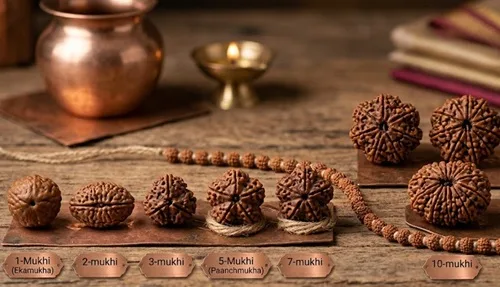
Rudraksha is considered a sacred seed associated with Lord Shiva in the Hindu spiritual tradition. The word "Rudraksha" is linked to Lord Rudra—another name for Shiva. Rudrakshas are primarily identified by the natural ridges or faces visible on their surface; these are known as Mukhi Rudrakshas.
In tradition, different Mukhi Rudrakshas are associated with specific deities, mantras, and spiritual purposes. Rudrakshas ranging from 1 Mukhi to 21 Mukhi are mentioned in texts, although not all varieties are equally common or easily available.
What are the types of Rudraksha?
The types of Rudraksha are primarily determined by the number of faces (Mukhis) they possess. For instance, a Rudraksha displaying five natural ridges or faces is known as a 5 Mukhi Rudraksha.
The commonly found Mukhi Rudrakshas include:
- 1 Mukhi Rudraksha
- 2 Mukhi Rudraksha
- 3 Mukhi Rudraksha
- 4 Mukhi Rudraksha
- 5 Mukhi Rudraksha
- 6 Mukhi Rudraksha
- 7 Mukhi Rudraksha
- 8 Mukhi Rudraksha
- 9 Mukhi Rudraksha
- 10 Mukhi Rudraksha
- 11 Mukhi Rudraksha
- 12 Mukhi Rudraksha
- 13 Mukhi Rudraksha
- 14 Mukhi Rudraksha
- 15 to 21 Mukhi Rudraksha
1 Mukhi Rudraksha
The 1 Mukhi Rudraksha is considered extremely special among all Rudrakshas. Traditionally, it is associated with Lord Shiva and focused spiritual practice (sadhana).
It is associated with the practices of meditation, introspection, and spiritual advancement.A natural and authentic 1-Mukhi Rudraksha is considered rare; therefore, special care should be taken when purchasing one.
2-Mukhi Rudraksha
The 2-Mukhi Rudraksha is traditionally associated with the Ardhanarishvara form. It is considered a symbol of the oneness of Lord Shiva and Mother Shakti. In spiritual tradition, it is linked to balance, harmony, and the spirit of relationships.
3-Mukhi Rudraksha
The 3-Mukhi Rudraksha is traditionally associated with Agni Dev (the Fire God). It is linked to the spiritual concept of liberation from past negative impressions and mental burdens. In spiritual practice, it is used as a symbol of self-purification and new beginnings.
4-Mukhi Rudraksha
The 4-Mukhi Rudraksha is associated with Lord Brahma. It is known for its traditional significance regarding knowledge, creativity, study, and speech. Students and seekers of knowledge wear it during their spiritual practices.
5-Mukhi Rudraksha
The 5-Mukhi Rudraksha is one of the most widely used Rudrakshas. It is associated with the 'Kalagni Rudra' form of Lord Shiva and is extensively used for daily chanting (Japa), meditation, and spiritual practices.
A 5-Mukhi Rudraksha mala (rosary) consisting of 108 beads is also used for mantra chanting. It is generally considered one of the simplest options for beginners on the spiritual path.
6-Mukhi Rudraksha
The 6-Mukhi Rudraksha is traditionally associated with Lord Kartikeya. It is considered a symbol of spiritual qualities such as discipline, self-confidence, and concentration.
7-Mukhi Rudraksha
The 7-Mukhi Rudraksha is traditionally associated with the Saptamatrikas and wealth-prosperity. It is worn with the aspiration for financial stability, prosperity, and a balanced life.
8-Mukhi Rudraksha
The 8-Mukhi Rudraksha is traditionally associated with Lord Ganesha. Since Lord Ganesha is known as the 'Vighnaharta' (Remover of Obstacles), this Rudraksha is linked to the removal of hurdles and the desire for success in new endeavors.
9-Mukhi Rudraksha
The 9-Mukhi Rudraksha is associated with Goddess Shakti and the various forms of Navdurga. It is considered a symbol of courage, strength, and spiritual energy.
10-Mukhi Rudraksha
The 10-Mukhi Rudraksha is traditionally associated with Lord Vishnu. It is worn with the intention of fostering balance, protection, and spiritual stability in life.
11-Mukhi Rudraksha
The 11-Mukhi Rudraksha is traditionally associated with the Ekadash Rudras (the eleven forms of Lord Shiva) and, in some traditions, with Lord Hanuman. It is considered a source of courage, inner strength, and spiritual power.
12-Mukhi Rudraksha
The 12-Mukhi Rudraksha is associated with the Sun God (Surya Dev). It is traditionally regarded as a symbol of radiance, self-confidence, leadership, and energy.
13-Mukhi Rudraksha
The 13-Mukhi Rudraksha is traditionally associated with Kamadeva (the God of Love) and, in some traditions, with Lord Indra. It is linked to charisma, willpower, and the fulfillment of both worldly and spiritual aspirations.
14-Mukhi Rudraksha
The 14-Mukhi Rudraksha is considered to be especially associated with Mahadev (Lord Shiva). In traditional belief, it is viewed as a symbol of intuition, wisdom, and decision-making ability.
15 to 21-Mukhi Rudraksha
Rudrakshas with 15, 16, 17, 18, 19, 20, and 21 faces (mukhis) are also mentioned in various Rudraksha traditions and scriptures.
These are considered relatively rare and are associated with various deities and spiritual concepts.Special caution is required when purchasing these rare *Mukhi* (faced) Rudrakshas, as there is a high risk of encountering fake or artificially manufactured beads in the market.
Quick Reference Table for *Mukhi* Rudrakshas
| *Mukhi* (Face) | Traditional Association | Primary Spiritual Significance |
|---|---|---|
| 1 *Mukhi* | Lord Shiva | Spiritual practice and concentration |
| 2 *Mukhi* | Ardhanarishvara | Balance and harmony |
| 3 *Mukhi* | Agni (Fire) | Purification and new beginnings |
| 4 *Mukhi* | Brahma | Knowledge and creativity |
| 5 *Mukhi* | Kalagni Rudra | Daily *Japa* (chanting) and meditation |
| 6 *Mukhi* | Kartikeya | Discipline and concentration |
| 7 *Mukhi* | Traditions related to prosperity | Prosperity and stability |
| 8 *Mukhi* | Ganesha | Freedom from obstacles |
| 9 *Mukhi* | Goddess Shakti | Power and courage |
| 10 *Mukhi* | Vishnu | Protection and balance |
| 11 *Mukhi* | Ekadash Rudra | Inner strength and courage |
| 12 *Mukhi* | Surya (Sun) | Radiance and self-confidence |
| 13 *Mukhi* | Kamadeva/Indra tradition | Attraction and willpower |
| 14 *Mukhi* | Shiva | Wisdom and intuition |
Rudraksha Mala...
TypesRudraksha is used not only as individual beads but also in the form of a mala (rosary). A Rudraksha mala with 108 beads is particularly popular for mantra chanting. Additionally, malas with 27 or 54 beads are used in various spiritual practice traditions.
When choosing a mala, keep in mind that its natural authenticity, proper structure, and suitability for your spiritual practice are more important than the number of beads.
Things to consider before wearing Rudraksha?
Rudraksha is worn in the context of religious faith and spiritual practice. Before wearing it, one may follow rituals such as worship, mantra chanting, or purification according to one's tradition.
Claims regarding miraculous health benefits associated with Rudraksha should not be considered a substitute for scientific medical treatment. Its spiritual benefits are primarily based on religious and traditional beliefs.
Identifying genuine Rudraksha
Exercise caution when purchasing Rudraksha, especially rare varieties (such as those with specific numbers of *mukhis* or faces). It is not advisable to buy an expensive Rudraksha based solely on the number of faces. It is better to purchase from a reliable seller and verify its authenticity if necessary.
- The natural faces (*mukhis*) and ridges should be clearly visible.
- Be wary of rare Rudraksha beads offered at unusually low prices.
- Consider obtaining a certificate or an independent test report for rare Rudraksha beads.
- Do not buy Rudraksha based solely on claims of miraculous benefits.
Which Rudraksha is best for meditation and chanting?
The 5-mukhi Rudraksha is one of the most popular choices for general meditation and mantra chanting. A mala made of 108 such beads is commonly used for daily mantra chanting.
Which Rudraksha is suitable for a specific spiritual practice (*sadhana*) may depend on your tradition, the nature of the practice, and your personal objective.There are various types of Rudraksha, and in Indian spiritual tradition, each *mukhi* (facet) is associated with a specific deity and symbolic meaning. The 5-mukhi Rudraksha is one of the most common choices for daily chanting (*japa*) and meditation, whereas rare-mukhi Rudrakshas are associated with specialized spiritual practices.
The true significance of a Rudraksha lies not merely in the number of its facets, but also in the reverence, mantra chanting, meditation, and regular spiritual practice associated with it.
Om Namah Shivaya. Hara Hara Mahadeva.