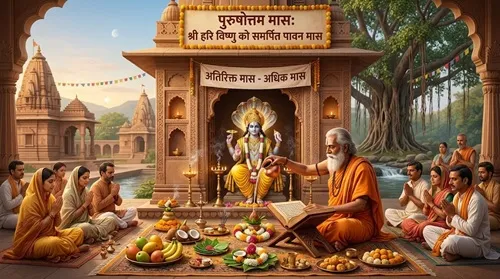
Adhik Maas is also known as Athirik Maas, Malmas and Purushottam Maas. An extra lunar month occurs approximately every three years to maintain the time balance in the lunisolar calculations of the Hindu calendar. In religious tradition, this month is considered to be dedicated to the Purushottam form of Lord Vishnu.
Adhik Maas is generally considered special for devotion, worship, chanting, penance, charity and religious practice. For this reason, it is also called Purushottam Maas.
Important: The start and end dates of Adhik Maas are not the same every year. It depends on the astronomical calculations of the calendar. Therefore, for the date of Adhik Maas in a particular year, one should refer to the local calendar of that year.
What is Adhik Maas?
In the Hindu calendar, there is a difference between the duration of the lunar month and the solar year. The lunar year is approximately 354 days long, while the solar year is approximately 365 days long. To balance the difference between the two calculations, an extra lunar month is added from time to time.
This extra lunar month is called Adhik Maas or Athirik Maas.
When there is no solar solstice in a lunar month, then that month is determined as Adhik Maas as per the calculations of the calendar.
Why is Adhik Maas called Purushottam Maas?
In religious tradition, Adhik Maas is associated with the Purushottam name of Lord Vishnu. It is believed that Lord Vishnu accepted this extra month in his name and gave it special religious significance.
For this reason, special importance is given to the worship of Lord Vishnu, Shri Hari and Lord Purushottam, chanting of names, fasting, story telling, charity and religious practice in Adhik Maas.
Why is Adhik Maas called Malmas?
The term Malmas is also popular for Adhik Maas. However, in religious tradition, it is not considered inauspicious and is expected to be completely avoided. Rather, due to the recognition of Purushottam Maas, this time is considered important for the devotion of God and spiritual practice.
In particular, the tradition of not performing wish-oriented auspicious rituals and some auspicious works during this period is found in many Hindu families and calendar traditions.
Religious significance of Adhik Maas
The worship of Lord Vishnu is considered to be of special importance in Adhik Maas. Devotees increase religious activities in their daily lives during this time.
According to religious beliefs, in Adhik Maas:
Remembering Lord Vishnu is considered auspicious.
Vishnu mantras are chanted.
Srimad Bhagavad Gita and texts related to Vishnu are recited.
Tulsi leaves are offered to Lord Vishnu.
Vrats and fasts are observed.
Donations are given to the needy people.
Tirtha bathing and religious visits are considered important.
Katha, satsang and bhajans are performed.
Worship of Lord Vishnu in Adhik Maas
Lord Vishnu can be worshiped in a simple way in Purushottam Maas.
Worship Materials
Picture or idol of Lord Vishnu
Yellow flowers
Tulsi leaves
Sandalwood
Akshat
Incense
Lamp
Fruits
Naivedya
clothes.Clean the place of worship.
Install the idol or picture of Lord Vishnu.
Light the lamp and Light incense.
Offer sandalwood, flowers and Tulsi leaves to Lord Vishnu.
Sahasranama, Bhagavad Gita or Vishnu Stuti. Vasudevaya॥Vishnu Sahasranama
MaasShri Hari Stuti
Vishnu Mantra
Rama Naam Japa
Krishna Naam Sankirtan
Food
Clothes
Fruits
Jaggery
Ghee
Yellow items
Religious books
In cow service or other service works Cooperation
Help to needy people
Marriage
Griha Pravesh
Auspicious rites like Upanayana
Starting new auspicious works on a large scale
This is considered to be the famous twelve-letter mantra of Lord Vishnu.
Devotees can chant the mantra a certain number of times as per their faith and convenience. You can.
Which recitations should be done in Adhik Maas?
Religious texts and stotras related to Lord Vishnu are recited in Purushottam Maas.
Main recitations
Devotes can include any one or more of these recitations in their daily practice as per their faith and time.
Fasts in Adhik Maas
Many devotees observe fasts or vrats in Adhik Maas as per their capacity. The nature of the fast may vary according to the tradition, health and resolve of the individual.
Some people eat sattvik food throughout the month, while some devotees observe fast on special dates.
The purpose of the fast is not only to abstain from food but also to concentrate on the devotion of God by controlling the mind, words and deeds.
What to donate in Adhik Maas?
According to religious belief, charity has special significance in Adhik Maas.
The following items can be donated as per one's capacity:
Donation should always be done as per one's capacity and keeping in mind the actual need of the needy person.
What should be done in Adhik Maas?
To make Adhik Maas useful for religious practice, devotees can do the following:
1. Chanting the name of Lord Vishnu
Remember the name of Shri Hari every day.
2. Tulsi Puja
Tulsi is considered dear to Lord Vishnu. Therefore, Tulsi puja and offering of Tulsi leaves are done with devotion.
3. Recitation of religious texts
Gita, Vishnu Sahasranaam or other religious texts can be recited.
4. Charity and service
Helping the needy and donating food, clothes etc. is considered religiously virtuous.
5. Satvik Life
Try to live a restrained life by avoiding anger, ego and unnecessary disputes.
What should not be done in Adhik Maas?
Religious traditions hold the belief of postponing certain desirable and auspicious functions during Adhik Maas.
Generally, caution is exercised during this period regarding the following types of functions:
However, these rules may vary according to the region, sect and calendar tradition. Therefore, it is advisable to consult your family tradition or a learned Acharya for any particular ritual.
Relation of Adhik Maas and Sankranti
Adhik Maas is identified by special calculations of the Hindu calendar. When during a lunar month there is no transit of the Sun from one zodiac sign to another, then that lunar month is determined as Adhik Maas.
For this reason, the name of Adhik Maas is also understood on the basis of that normal month, like Adhik Shravan, Adhik Bhadrapada etc.
Pilgrimage bath in Adhik Maas
According to religious belief, pilgrimage bath, river bath and visiting religious places have special importance in Adhik Maas.
A person who cannot go on a pilgrimage can express his devotion by remembering God, worshipping and chanting mantras after bathing at home.
Importance of Tulsi in Adhik Maas
Tulsi is considered to be of special importance in the worship of Lord Vishnu. Therefore, offering Tulsi leaves to Lord Vishnu in Purushottam month is one of the major religious traditions of the devotees.
Service to the Tulsi plant, lighting lamps and worshipping it can also be done with devotion.
Story of Adhik Maas
In religious stories, Adhik Maas was initially considered neglected and no god was ready to accept it. Due to this, Adhik Maas took refuge in Lord Vishnu.
According to belief, Lord Vishnu accepted its prayer and bestowed it with his name Purushottam. For this reason, Adhik Maas came to be known as Purushottam Maas.
The religious message of this story is that with the refuge and devotion of God, even a thing considered neglected can attain special importance.
Worship of Lord Purushottam in Adhik Maas
During Purushottam Maas, devotees meditate on the Purushottam form of Lord Vishnu.
After taking bath in the morning, one can meditate on the Lord and pray as follows:
O Lord Purushottam,
Bless us with your devotion in this holy month.
Give our minds wisdom and restraint.
Inspire us to follow the path of righteousness and truth
And give us the feeling of kindness and service towards all living beings.
Major religious activities performed in Adhik Maas
| Religious activities | Traditional significance |
|---|---|
| Vishnu worship | Devotion to Shri Hari |
| Mantra chanting | Spiritual Sadhana |
| Vishnu Sahasranama | Remembering Lord Vishnu |
| Gita recitation | Contemplation of knowledge and religion |
| Tulsi worship | Relation to Vishnu devotion |
| Donation | Service and virtue Emotions |
| Fasting | Abstinence and Sadhana |
| Katha-Satsang | Religious knowledge and devotion |
Diet in high months
The devotees observing fast eat fruits or sattvik food as per their tradition. Generally, there is a religious tradition of maintaining restraint in food and giving preference to Satvik diet.
If a person cannot fast due to health reasons, then he should not observe strict fast without any need. It is more appropriate to do devotion and spiritual practice as per one's capacity.
Adhik Maas and auspicious works
Worship and religious practices are considered auspicious in Adhik Maas, but different religious rules are prevalent regarding auspicious rituals like marriage.
Therefore, it is important to understand that Adhik Maas does not mean prohibition of all auspicious works. Religious activities like worship of God, chanting of mantras, donation, story telling and service are performed, while some auspicious rituals are avoided as per tradition.
In how many years does Adhik Maas occur?
Adhik Maas generally occurs approximately once every 32 to 33 months. Simply put, it is called an extra lunar month that comes at an interval of about three years.
The actual difference depends on the astronomical calculations of the calendar.
Spiritual message of Adhik Maas
Purushottam Maas gives us the message that even extra time in life can be made meaningful.
During this period, devotees try to spare some time amidst worldly engagements for remembering God, introspection, service, charity and good conduct.
Adhik Maas is therefore not just an extra month added to the calendar, but is considered an opportunity for devotion and self-meditation from a religious point of view.
FAQ: Adhik Maas
1. What is Adhik Maas?
The extra lunar month added to maintain the balance of time in the Hindu lunisolar calendar is called Adhik Maas.
2. Why is Adhik Maas called Purushottam Maas?
According to religious belief, Lord Vishnu accepted Adhik Maas as his Purushottam name. Hence it is called Purushottam Maas.
3. Why is Adhik Maas called Malmas?
The name Malmas is also popular for Adhik Maas. This name is found in traditional calendars and religious literature.
4. Which God should be worshipped in Adhik Maas?
The worship of Lord Vishnu and Lord Purushottam is considered especially important in Adhik Maas.
5. Which mantra should be chanted in Adhik Maas?
The mantra “Om Namo Bhagwate Vasudevaya” can be chanted to worship Lord Vishnu.
6. Can marriage be performed during Adhik Maas?
Many Hindu religious traditions prohibit marriage and certain other auspicious ceremonies during Adhik Maas. It is advisable to consult the local almanac and acharya for individual circumstances.
7. What should be donated during Adhik Maas?
Donations such as food, clothing, fruits, religious materials, and assistance to the needy can be made according to one's capacity.
8. Is it necessary to observe a fast during Adhik Maas?
No. Fasting is done according to one's faith and ability. A person who is unable to observe a fast due to health or other reasons can perform other religious activities such as worship, chanting mantras, charity, and service.
9. After how many years does Adhik Maas occur?
Adhik Maas generally occurs at an interval of approximately 32 to 33 months, hence it is generally called the extra month, occurring approximately once every three years.
10. Can we perform puja and rituals during Adhik Maas?
Yes. In religious tradition, Adhik Maas is considered special for puja, chanting, penance, storytelling, charity and adoration of Lord Vishnu.
Adhik Maas (Extra Maas/Purushottam Maas) is an important concept in the Hindu calendar. It is an additional lunar month added to the calendar to maintain balance between the lunar and solar year.
Religiously, it is considered dedicated to the Purushottam form of Lord Vishnu. During this period, devotees pursue their spiritual practice through puja, chanting mantras, fasting, storytelling, charity, service and self-reflection.
Om Namo Bhagavate Vasudevaya.
Victory to Lord Purushottam.