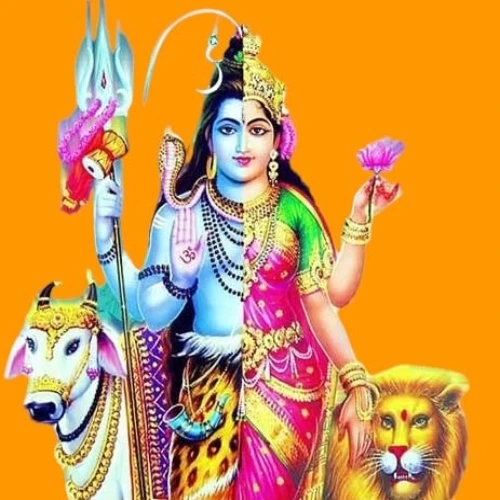
Ardhanarishvara Stotra is a beautiful hymn dedicated to Ardhanarishvara, the combined form of Lord Shiva and Goddess Parvati. It describes the existence of Lord Shiva and Goddess Shakti in one form. This stotra symbolizes the non-dual nature of Shiva and Shakti, the balance of creation, and the coordination between man and nature.
Each verse in this stotra beautifully describes the form, ornaments, eyes, hair, clothing, and the forms of creation and destruction of Goddess Parvati and Lord Shiva.
Who is Ardhanarishvara?
Ardhanarishvara is the combined form of Lord Shiva and Goddess Parvati, in which one part of the body is considered to be of Lord Shiva and the other part is of Goddess Parvati.
This form symbolizes that Shiva and Shakti are not separate from each other. Shiva symbolizes consciousness, while Shakti is considered to be the form of creation and activity.
The unity of Goddess Parvati with Lord Shiva in the Ardhanarishvara form represents the balance of man and nature, consciousness and energy, and creation and destruction in the world.
Full text of Ardhanarishvara Stotra Text
shlok 1
chaampeyagauraardhasharirakaye
karpuragauraardhasharirakay .
dhammillakaye ch jatadharay
namah shivaye ch namah shivay ॥ 1 ॥shlok 2
kasturikakunkumacharchitaye
chitarajahpnjavicharchitay .
krutasmaraye vikrutasmaray
namah shivaye ch namah shivay ॥ 2 ॥shlok 3
jhanatkvanatkankananupuraye
padabjarajatphaninoopuray .
hemangadaye bhujagangaday
namah shivaye ch namah shivay ॥ 3 ॥Shlok 4
vishalanilotpalalochanaye
vikasipankeruhalochanay .
samekshanaye vishamekshanay
namah shivaye ch namah shivay ॥ 4 ॥Shlok 5
Mandaramalakalitalakaye
kapalamalaankitakandharay .
divyambaraye ch digambaray
namah shivaye ch namah shivay ॥ 5 ॥Shlok 6
ambhodharashyamalakuntalaye
tatitprabhatamrajatadharay .
nirishvaraye nikhileshvaray
namah shivaye ch namah shivay ॥ 6 ॥Shlok 7
prapanchasrishtunmukhalasyakaye
samastasanharakataandavay .
jagajjananyai jagadekapitre
namah shivaye ch namah shivay ॥ 7 ॥Shlok 8
pradiptaratnojjvalakundalaye
sphuranmahapannagabhushanay .
shivanvitaye ch shivanvitay
namah shivaye ch namah shivay ॥ 8 ॥Falashruti
etatpathedashtakamishtadam yo
bhaktya sa manyo bhuvi dirghajivi .
prapnoti saubhagyamanantakalam
bhuyatsada tasya samastasiddhih ॥iti shri adishankarabhagavatpad virachitam ardhanarishvarastotram sampurnam.
Simple Meaning of Ardhanarishwar Stotra
Meaning of Verse 1
Half of the body of Mother Parvati is as white as the flower of Champa and half of the body of Lord Shiva is as bright as camphor. Mother Parvati has beautiful hair and Lord Shiva has matted hair. Such is the salutation to Mother Shiva and Lord Shiva.
Meaning of Verse 2
The body of Mother Parvati is adorned with musk and saffron, while the body of Lord Shiva is adorned with the ashes of the coffin. Mother Parvati is the embodiment of beauty that produces lust and Lord Shiva is the suppressor of Cupid. Such Shiva and Shiva is saluted.
Meaning of Verse 3
The hands and feet of Mother Parvati have the sweet sound of bracelets and anklets. Lord Shiva's feet are adorned with snakes like anklets. Mother Parvati wears gold ornaments and Lord Shiva wears snakes as ornaments. Both are saluted.
Meaning of Verse 4
The eyes of Mother Parvati are beautiful and vast like blue lotuses, while the eyes of Lord Shiva are as beautiful as lotuses. Mata Parvati sees the world with both eyes and is also the third eye of Lord Shiva. Obeisance to such Shiva-Shakti form.
Meaning of verse 5
Mata Parvati's hair is adorned with a garland of mandara flowers, while Lord Shiva's shoulder is adorned with a garland of skulls. Mother Parvati wears divine clothes and Lord Shiva is seated in Digambar form.
Meaning of Verse 6
Mother Parvati's hair is dark like clouds and Lord Shiva's matted hair appears to be as bright as lightning. Mother Parvati herself is not subject to anyone and Lord Shiva is the God of the entire universe. Mother Parvati is the mother of the world and Lord Shiva is the only father form of the world.
This verse specifically shows the balanced nature of creation and destruction of Ardhanarisvara. Both Mother Parvati and Lord Shiva are the combined forms of Shiva-Shakti. Such Ardhanarisvara is repeatedly saluted.
Importance of Ardhanarisvara Stotra
Ardhanarisvara Stotra reminds us of the integral relationship between Shiva and Shakti. In religious tradition, it is recited as worship of Lord Shiva and Mother Parvati.
Through this stotra, devotees can:
Remember Lord Shiva and Mother Parvati.
Meditate on the unity of Shiva-Shakti are.
Can pray for love and harmony in the family.
Strengthen a sense of balance and positivity in your life.
These benefits should be understood in the context of religious faith and tradition.
When to recite Ardhanarishwar Stotra?
Ardhanarishwar Stotra can be recited with devotion on any day. It is recited especially on the days associated with the worship of Lord Shiva.
You can recite it on the following occasions:
Monday
Pradhosh Vrat
Mahashivratri
Shiva-Parvati Puja
Shravan Mass
Religious worship related to marriage and conjugal life
Daily Shiva worship
It is advisable to prioritize faith and regularity rather than assume that adherence to a particular time for recitation is mandatory.
Ardhanarisvara Stotra recitation method
Clean the place of worship.
Meditate on the half-woman form of Lord Shiva and Mother Parvati.
Light lamps and incense.
Offer water or Ganga water to Lord Shiva.
Remember Mother Parvati and Lord Shiva
Recite Ardhanarishwar Stotra with devotion.
Finally, pray to Lord Shiva and Mother Parvati for happiness, peace and balance in family and life
Spiritual Message of Ardhanarishwar Swaroop
Ardhanarishwar Swaroop not only depicts the combined form of Shiva and Parvati, but also conveys the message of balance in life is.
Shiva is passive without power and power is considered baseless without Shiva.Therefore, the Ardhanarisvara form represents the interrelationship of consciousness and energy.
This form reminds us of the importance of balance, cooperation, compassion, perseverance and creativity in life It is a beautiful hymn to the wonderful combined form. This Ashtaka, associated with Adi Shankaracharya, contains poetic descriptions of the form, ornaments, eyes, hair and divine nature of creation and destruction of Shiva and Shakti. Understanding its meaning with regular reading can help us experience the spiritual spirit of the hymn more deeply.