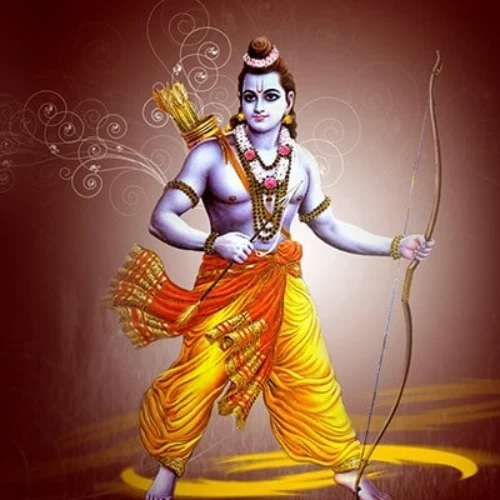
“Bhae Pragat Kripala, Deen-Dayala, Kaushalya Hitkari” is a highly renowned hymn from the episode of Lord Shri Ram’s birth, as described in the *Bal-Kand* (the first section) of the *Shri Ramcharitmanas*. It beautifully depicts Lord Shri Ram appearing before Mother Kaushalya in His divine four-armed form, the prayer offered by the Mother, and the Lord subsequently assuming the form of an infant.
This hymn is sung and recited with deep devotion during celebrations of Lord Shri Ram’s birth, particularly on the occasion of Shri Ram Navami. In it, Lord Shri Ram is revered as an ocean of compassion, one who shows mercy to the downtrodden, and a benefactor of His devotees.
Bhae Pragat Kripala – Complete Text
bhaye pragat kripala, dindayala, kousalya hitkari.
harashit mahtari, muni man hari, adbhut roop bichari॥
lochan abhirama, tanu ghansyama, nij aayudh bhujachari.
bhushan banmala, nayan bisala, sobhasindhu kharari॥
kah dui kar jori, astuti tori, kehi bidhi karun ananta.
maya gun gyanatit amana, ved puran bhananta॥
karuna sukh sagar, sab gun aagar, jehi gaonhi shruti santa.
so mam hit lagi, jan anuragi, bhayau pragat shrikanta॥
brahmand nikaya, nirmit maya, rome rome prati bed kahai.
mam ur so basi, yah upahasi, sunat dheer mati thir na rahai॥
upja jab gyana, prabhu musukana, charit bahut bidhi kinh chahai.
kahi katha suhai, matu bujhai, jehi prakar sut prem lahai॥
mata puni boli, so mati doli, tajahu taat yah rupa.
keejai sisulila, ati priyasila, yah sukh param anupa॥
suni bachan sujana, rodan thana, hoi balak surbhupa.
yah charit je gavahin, haripad pavahin, te na parahin bhavkupa॥
bhaye pragat kripala, dindayala, kousalya hitkari.
harashit mahtari, muni man hari, adbhut roop bichari॥
doha
vipra dhenu sur sant hit leanh manuj avtar.
nij ichchha nirmit tanu maya gun gopar॥
siyavar ramchandra ki jay.
Simple Meaning of “Bhae Pragat Kripala”
Lord Shri Ram is the embodiment of compassion and is merciful to the downtrodden. He manifested for the sake of Mother Kaushalya. Upon beholding His divine form—a wondrous sight that captivated the minds of sages—Mother Kaushalya was filled with immense joy.
Lord Shri Ram’s complexion was dark like a rain-bearing cloud. His eyes were exceedingly beautiful and large. He held divine weapons in His hands and was adorned with a garland of forest flowers and various ornaments; His form was like an unfathomable ocean of beauty.
Mother Kaushalya’s Hymn of Praise
Upon witnessing the Lord’s divine form, Mother Kaushalya offers prayers with folded hands. She asks, "O Infinite Lord! How can I praise You? You transcend *Maya* (illusion) and its attributes. Even the Vedas and Puranas describe Your true nature."
She addresses the Lord as an ocean of compassion and bliss, and a repository of all virtues. She marvels at the fact that the Supreme Being—whose abode is the entire universe and within whose every pore countless universes are said to exist—has manifested before her as her own son.
Lord Shri Ram Assumes the Form of an Infant
When Mother Kaushalya realizes the Lord's divine nature, the Lord smiles and expresses a desire to enact His divine childhood pastimes (*Bal-Lila*). Mother Kaushalya requests Him to set aside His divine form and assume the guise of an ordinary infant, so that she may hold Him in her lap as a son and experience the bliss of maternal affection.
Hearing His mother's wish, Lord Shri Ram begins to cry like an infant. Thus, honoring the love of His devotees and parents, the Lord engages in His childhood pastimes.
Meaning of the *Doha* (Couplet)
The Doha explains the purpose of Lord Shri Ram’s incarnation. The Lord incarnated in human form for the welfare of Brahmins, cows, gods, and sages.
His body is created by His own will, and He transcends Maya (illusion) and its attributes.Religious Significance of “Bhae Pragat Kripala”
This hymn holds special emotional and spiritual significance for the devotees of Lord Shri Ram. The birth of Lord Shri Ram is viewed not merely as a historical or religious event, but as a symbol of the establishment of Dharma (righteousness), Maryada (moral propriety), compassion, and truth. The term “Deendayala” (Compassionate to the distressed) reflects the Lord's compassionate nature. For the devotee, the message is that the Lord harbors compassion for His devotees and accepts their surrender.Recitation on Shri Ram Navami
On the occasion of Shri Ram Navami—celebrating the birth of Lord Shri Ram—the hymn “Bhae Pragat Kripala” is specially recited and sung. Devotees sing this hymn with deep devotion in temples and homes during the celebrations of Ram's birth. On this occasion, rituals such as the worship of Lord Shri Ram, the chanting of His name, the recitation of the *Ramcharitmanas*, and the Aarti are performed. Devotees pray to the Lord for the wisdom to walk the path of truth, righteousness, moral propriety, and virtuous conduct.The Message Conveyed by This Hymn
The most beautiful message of “Bhae Pragat Kripala” is that of the love shared between the Lord and the devotee. Despite being the Supreme Being, the Lord assumes the form of a child out of love for His devotees. Mother Kausalya’s maternal affection and the divine childhood pastimes (Bal Leela) of Lord Shri Ram make this episode deeply moving. This hymn also reminds us that in devotion to God, love and surrender hold as much significance as knowledge.Conclusion
“Bhae Pragat Kripala, Deendayala, Kausalya Hitkari” is a beautifully devotional description of Lord Shri Ram’s birth and His childhood pastimes. It encompasses the Lord's divine nature, the praise offered by Mother Kausalya, and the narrative of the Lord assuming the form of a child. This hymn can be recited with devotion and love on the occasion of Shri Ram Navami and during daily devotion to Shri Ram.Victory to Siyavar Ramchandra. Victory to Pavansut Hanuman. Shri Ram, Jai Ram, Jai Jai Ram.