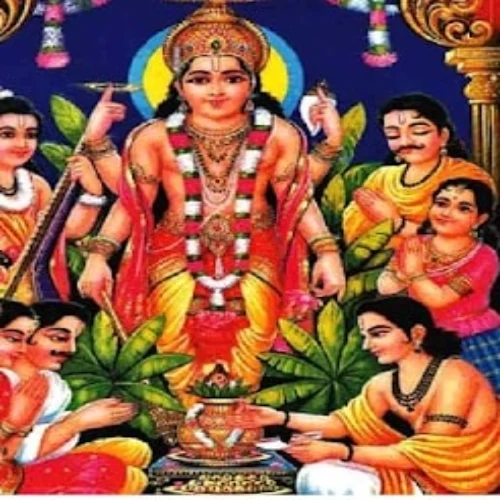
Lord Satyanarayan is considered the embodiment of Truth—an avatar of Lord Shri Hari Vishnu. References to the Satyanarayan Vrat (vow/fast) and Katha (narrative) are found in the Reva Khanda of the Skanda Purana. Religious belief holds that those who observe the Satyanarayan Vrat and listen to the Katha with faith, truthfulness, and devotion are blessed with happiness, prosperity, peace, and the grace of Lord Vishnu.
The Satyanarayan Vrat can be performed on any auspicious occasion—such as a housewarming ceremony, a wedding, the birth of a child, the start of a new business, success in examinations, the fulfillment of a wish, or on the day of the full moon (Purnima).
Who is Lord Satyanarayan?
Lord Satyanarayan is the divine form of Lord Vishnu that symbolizes truth, righteousness (Dharma), compassion, and justice. "Satya" signifies adherence to truth, and "Narayana" refers to Lord Vishnu, the preserver of the entire universe. This fast is not merely a means to acquire wealth; it inspires one to lead a life grounded in truth, service, charity, and righteousness (Dharma).
Significance of the Satyanarayan Vrat
According to religious beliefs, the Satyanarayan Vrat—
- Inspires the maintenance of peace and happiness within the family.
- Strengthens devotion to Lord Vishnu.
- Teaches the importance of speaking the truth and adhering to righteousness.
- Is observed with reverence for the fulfillment of wishes.
- Is a popular fast observed before auspicious occasions.
Satyanarayan Puja Materials
The following items are generally required for the worship—
- Image of Lord Vishnu or Lord Satyanarayan
- A low wooden platform (Chauki) and a yellow cloth
- Kalash (sacred pot)
- Mango leaves
- Coconut
- Roli (vermilion)
- Turmeric
- Rice (Akshat)
- Panchamrit
- Ganga water
- Tulsi leaves
- Five types of fruits
- Betel nut (Supari)
- Dhoop (incense powder/resin)
- Lamp (Deep)
- Ghee
- Agarbatti (incense sticks)
- Flowers
- Bananas
- Betel leaves (Paan)
- Cloves
- Cardamom
- Naivedya (food offering)
- Prasad (Halwa or Shira made from semolina or wheat flour)
Satyanarayan Puja Rituals
- Bathe in the morning and wear clean clothes.
- Purify the place of worship.
- Place the image of Lord Satyanarayan on the wooden platform.
- Install the Kalash.
- Invoke Lord Ganesha.
- Meditate upon Lord Vishnu and Goddess Lakshmi.
- Perform worship using Panchamrit.
- Offer Tulsi leaves.
- Offer Naivedya.
- Read or listen to the story (Katha) of Lord Satyanarayan.
- Perform the Aarti.
- Distribute the Prasad among all devotees.
Shri The Complete Story of Lord Satyanarayan
Chapter One – Sage Narada’s Question
Invocation
Om, salutations to Lord Ganesha.
Om, salutations to Lord Vasudeva.
Om, salutations to Lord Satyanarayan.
Once, in the sacred forest known as Naimisharanya, numerous sages and seers gathered and asked Suta Ji about a simple yet excellent way to ensure the welfare of living beings in the Kali Yuga. They humbly asked—
"O Suta Ji! In the Kali Yuga, human beings are beset by various kinds of sorrows, sins, and hardships. What is that specific vow or spiritual practice by performing which a person can be relieved of all sorrows and attain wealth, grain, progeny, happiness, prosperity, and ultimately, liberation (Moksha)?"
Hearing this question from the sages, Suta Ji replied—
"O noble sages! You have asked a question that brings immense well-being. This is the very story that Lord Vishnu Himself narrated to the divine sage Narada. I shall now recount that sacred story to you all."
Once, while wandering through various worlds, the divine sage Narada arrived at Mrityuloka (the mortal world). There, he observed that human beings were suffering various kinds of sorrows according to their respective karmas. Some were destitute, some ailing, some childless, while others were tormented by mental anguish. Witnessing this, compassion arose in his heart.
Narada Ji immediately proceeded to Vaikuntha, the abode of Lord Sri Hari Vishnu. There, he beheld the Lord seated upon a divine throne alongside Goddess Lakshmi, bearing the conch, discus, mace, and lotus. Offering reverent salutations, he said—
"O Lord! You are the Sustainer of the entire universe and are deeply affectionate towards Your devotees. Humans on earth suffer from various kinds of afflictions. Please prescribe a simple vow that can alleviate all their sorrows and grant them happiness, prosperity, and ultimately, liberation."
Lord Vishnu smiled and said—
"O Narada! You have asked a most excellent question for the welfare of the world. I shall tell you of a supreme vow that fulfills all desires. It is known as the 'Shri Satyanarayan Vrat.' Whoever observes this vow with faith and devotion and listens to the story of My glory is cleansed of all sins. They attain wealth, grain, progeny, fame, happiness, and prosperity, and ultimately attain liberation."
The Lord further added—
"This vow may be observed on any auspicious day, particularly on Purnima (full moon day), Ekadashi, or Sankranti. After bathing in the morning or during the evening, perform My worship in a clean place. Offer Panchamrit, Tulsi leaves, fruits, flowers, incense, lamps, and Naivedya (sacred food offering). Offer Prasad prepared from wheat flour, ghee, milk, sugar, or semolina. Thereafter, listen to the *Shri Satyanarayan Vrat Katha* with devotion, and finally, distribute the *Prasad* among all the devotees."
The Lord said—
"Whoever observes this vow with reverence, faith, and sincerity sees all their wishes fulfilled. Life's adversities are dispelled, happiness and peace prevail in the family, and My special grace remains upon them."
Hearing these words from the Lord, the divine sage Narada was overjoyed. He bowed to the Lord, descended to Earth, and propagated this sacred vow, thereby bringing about the well-being of countless people.
॥ Thus concludes the first chapter of the Sri Satyanarayana Vrat Katha ॥
Shri Satyanarayan Vrat Katha – Chapter Two
The Story of the Impoverished Brahmin
Once, there lived an extremely poor Brahmin in the city of Kashi. He sustained his life by begging for alms every day. Despite enduring many hardships due to poverty, he remained righteous, truthful, and a devotee of the Lord.
One day, observing his pitiable condition, Lord Shri Satyanarayan assumed the form of an elderly Brahmin and approached him. He asked affectionately—
"O Brahmin! Why do you remain so sad and worried?"
The Brahmin replied humbly—
"O Noble Soul! I am extremely poor. I sustain my life solely on whatever alms I receive. Please suggest a way by which the well-being of myself and my family can be ensured."
The Lord, in the guise of the elderly Brahmin, said—
"If you observe the *Vrat* (vow) and perform the worship of Lord Shri Satyanarayan with faith and devotion, all your sorrows will vanish. You will attain wealth, grain, happiness, prosperity, and success in life."
Having said this, the Lord disappeared. The poor Brahmin realized that He was no ordinary human being, but Lord Shri Satyanarayan Himself.
The next day, the Brahmin went out to beg for alms. That day, he received more alms than usual. He resolved within himself that he would gather the necessary materials from whatever he received and observe the *Vrat* of Lord Shri Satyanarayan.
Within a few days, he collected the materials required for the worship. On an auspicious day, after bathing and purifying his mind, he performed the worship of Lord Shri Satyanarayan according to the prescribed rituals, listened to the sacred story, and distributed the Prasad among the devotees.
By the grace of the Lord, his poverty was dispelled. His home became filled with wealth, grain, happiness, prosperity, and joy. He began observing the Sri Satyanarayan Vrat with devotion every month and also started explaining the significance of this fast to others.
One day, the Brahmin recounted the glory of this fast to several people. Among them was a woodcutter. He reverently inquired about the procedure for the fast and resolved that if he earned a good income that day, he too would observe the Sri Satyanarayan Vrat.
॥ Thus concludes the Second Chapter of the Sri Satyanarayan Vrat Katha ॥
Shri Satyanarayan Vrat Katha – Chapter Three
The Story of the Woodcutter
When the impoverished Brahmin narrated the glory of the Shri Satyanarayan Vrat (ritual fast), a woodcutter present there listened to the story with deep reverence. He inquired about the complete procedure of the fast from the Brahmin and made a silent vow—
"If I earn a good income today by selling firewood, I will certainly observe the fast of Lord Shri Satyanarayan."
With this resolve, he went into the forest to cut wood. By the grace of the Lord, he found more wood that day than usual. When he arrived in the city to sell it, his entire stock was quickly sold at a good price. He was overjoyed by this.
Remembering his vow, he purchased the necessary items for the worship—bananas, fruits, flowers, Tulsi leaves, incense, a lamp, offerings (Naivedya), wheat flour, ghee, milk, sugar, and so on. He then returned home, invited his family and neighbors, and performed the worship of Lord Shri Satyanarayan with devotion, faith, and the prescribed rituals.
After the worship, he listened to the Shri Satyanarayan Vrat Katha, performed the Aarti (ritual of lights) for the Lord, and distributed the Prasad (sacred offering) among all the devotees. He prayed wholeheartedly to the Lord to always bestow His grace upon his family.
By the grace of Lord Shri Satyanarayan, his life transformed within a short time. Wealth, grain, happiness, prosperity, and abundance filled his home. Joy and peace prevailed within the family. He began observing the fast regularly and inspired others by sharing the glory of this ritual.
Thus, whoever observes the fast of Lord Shri Satyanarayan and listens to the story with reverence, truth, and faith sees all their sorrows dispelled and attains Dharma (righteousness), Artha (wealth), Kama (fulfillment of desires), and ultimately Moksha(liberation).
॥ Iti Shri Satyanarayan Vrat Katha Third Chapter ends.
Shri Satyanarayan Vrat Katha – Chapter Four
The Story of Sadhu Vaishya, Leelavati, and Kalavati
Once upon a time, a wealthy and pious merchant named Sadhu lived in a city. His wife’s name was Leelavati. Both were extremely virtuous and devoted to God, yet they had no children. They constantly prayed to the Lord, desiring to be blessed with offspring.
One day, a ritual observance (vrat) dedicated to Lord Shri Satyanarayan was being held in the city. Sadhu the merchant arrived there and listened to the sacred story with reverence. He made a solemn vow before the Lord—
"Oh Lord! If, by Your grace, I am blessed with a child, I shall certainly observe the fast of Shri Satyanarayan."
By the grace of the Lord, some time later, Leelavati gave birth to a beautiful daughter. She was named Kalavati. The girl grew up day by day; however, even after being blessed with a child, Sadhu the merchant forgot his vow and did not observe the fast of Shri Satyanarayan.
Time passed. When Kalavati came of age, she was married to a worthy and virtuous young man. Even after the wedding, Sadhu the merchant did not fulfill his vow.
Some time later, Sadhu the merchant traveled to a foreign land across the sea with his son-in-law to conduct business. There, he engaged in various trades and amassed great wealth. It was then that Lord Shri Satyanarayan decided to put him to the test.
One day, a theft occurred in that kingdom. Thieves were fleeing with wealth stolen from the royal treasury. When pursued, they discarded the stolen goods near Sadhu the merchant’s camp and fled. When the soldiers arrived at the spot, they found the stolen wealth in Sadhu the merchant's possession.
Without conducting a thorough investigation, they mistook Sadhu Vaishya and his son-in-law for thieves and imprisoned them. By the King's order, both were thrown into prison, and all their wealth and merchandise were confiscated for the royal treasury. Meanwhile, back home, Lilavati and Kalavati were unaware of these events. Gradually, their household wealth was exhausted, and they began to lead a life of great hardship and sorrow. One day, Kalavati went out in search of food. On her way, she came across a gathering where the vrat (ritual fast) and katha (narrative) of Lord Satyanarayan were being observed. She sat there with devotion, listened to the story, participated in the Aarti, and returned home after partaking of the Prasad. She recounted the entire experience to her mother, Lilavati. Lilavati immediately recalled her husband's forgotten vow. The very next day, mother and daughter observed the vrat of Lord Satyanarayan with full devotion and proper ritual procedure; they listened to the story, performed the Aarti, and distributed the Prasad among the devotees. They prayed to the Lord for the safety and swift return of the husband and son-in-law. Lord Satyanarayan was pleased with their devotion. That very night, the Lord appeared to the King in a dream and said— "O King! The two merchants you have imprisoned are innocent. Release them immediately with honor and return all their wealth. Otherwise, you and your kingdom will have to endure great suffering." In the morning, the King recalled the dream. He immediately released Sadhu Vaishya and his son-in-law from prison, apologized to them, returned all their wealth and property, and bade them farewell with honor. Thus, Lord Satyanarayan protected His devotees and demonstrated that anyone who observes the vrat with faith sees all their adversities dispelled. || Thus concludes the Fourth Chapter of the Sri Satyanarayan Vrat Katha ||Shri Satyanarayan Vrat Katha – Chapter Five
Sadhu Vaishya’s Disrespect for the *Prasad* and the Lord’s Grace
When Sadhu Vaishya and his son-in-law were honorably released by the King's order and all their wealth was returned, they set out for their hometown, filled with great joy.
On the way, Lord Shri Satyanarayan assumed the guise of an ascetic (an elderly Brahmin) and asked Sadhu Vaishya—
"O Merchant! What is loaded in your boat?"
Sadhu Vaishya had become arrogant about his wealth. He replied untruthfully—
"It contains nothing but leaves and creepers."
The Lord smiled and said—
"So be it! Let it happen exactly as you say."
When Sadhu Vaishya went to the boat and looked, all the precious wealth, gems, and merchandise stored within had indeed transformed into leaves and creepers. He was deeply distressed to see this. He immediately realized his mistake—that he had spoken a falsehood before the Lord.
He instantly fell at the ascetic's feet and said—
"O Lord! I have committed a grave offense out of ignorance. Please forgive me. I seek refuge in You."
Lord Shri Satyanarayan was pleased by his sincere, penitent prayer and said—
"One who forsakes the truth inevitably suffers. However, I certainly bestow My grace upon the person who acknowledges their mistake and seeks refuge in Me with faith and devotion."
As soon as He said this, all the wealth and merchandise in the boat reverted to their original state. Sadhu Vaishya bowed repeatedly to the Lord and resolved in his heart never to forget his vow again.
Meanwhile, in the city, Lilavati and Kalavati received the news of Sadhu Vaishya's return. Both worshipped the Lord and partook of the Prasad (sacred offering). However, in her eagerness to welcome her husband, Kalavati rushed towards the riverbank without consuming the *Prasad*.
Observing this disrespect towards the Prasad, Lord Sri Satyanarayana decided to test her. In an instant, the boat carrying her husband vanished from sight in the water. Seeing this, Kalavati began to lament.
Just then, a divine voice was heard from the heavens—
"O daughter! You have shown disrespect to the Lord's *Prasad*. First, partake of the *Prasad* with reverence, and then you shall be reunited with your husband."
Kalavati immediately returned home. She reverently partook of the Prasad of Lord Sri Satyanarayana and went back to the riverbank. By the grace of the Lord, the boat reappeared, and she was reunited with her husband safely.
Sadhu Vaishya, Lilavati, Kalavati, and their son-in-law performed the ritual worship of Lord Sri Satyanarayana, listened to the sacred story, performed the Aarti, and distributed the *Prasad* among all the devotees. Thereafter, they continued to observe the Sri Satyanarayana *Vrat* (vow) throughout their lives with faith, devotion, and truthfulness. Their home was blessed with happiness, peace, abundance, and prosperity, and in the end, they attained the Lord's supreme abode.
Significance of the Vrat
Any man or woman who observes the Vrat of Lord Sri Satyanarayana with faith, devotion, and truthfulness—listening to the story, respecting the Prasad, and distributing it among devotees—is relieved of all sorrows. They attain wealth, grain, progeny, fame, happiness, prosperity, and ultimately, Moksha (liberation).
॥ Thus concludes the Fifth Chapter of the Sri Satyanarayana Vrat Katha ॥
॥ Jai to Lord Shri Satyanarayan ॥
॥ Om Namo Bhagavate Vasudevaya Namah ॥
Chapter Six – The Story of King Tungadhvaja
King Tungadhvaja was a righteous ruler, but once, out of arrogance, he neglected the worship of Lord Satyanarayana.
He did not even partake of the Prasad (sacred offering).
Some time later, his kingdom, wealth, and family fell into distress.
He realized his mistake.
He observed the Vrat (vow/fast) of Lord Satyanarayana and partook of the Prasad with devotion.
By the grace of the Lord, he regained his kingdom, happiness, and prosperity.
Lessons from the Story
The story of Satyanarayana teaches us to—
- Always speak the truth.
- Have faith in God.
- Fulfill the vows we have made.
- Respect the *Prasad*.
- Renounce arrogance.
- Live a life of hard work and honesty.
- Engage in charity and service.
- Walk the path of righteousness (*Dharma*).
Aarti of Lord Satyanarayana
Om Jai Lakshmi Ramana, Swami Jai Lakshmi Ramana.
Satyanarayana Swami, remover of the sins of the people.
Seated on a gem-studded throne, He shines with a wondrous radiance.
Narada constantly chants His praise, while the temple bell resounds.
Om Jai Lakshmi Ramana...
He manifested for the sake of the *Kali Yuga* and granted a vision to a *Dwija* (Brahmin).
Appearing as an elderly Brahmin, He transformed a humble home into a golden palace.
Om Jai Lakshmi Ramana...
He bestowed grace upon a poor, humble Bhil woodsman.
He dispelled the misfortunes of King Chandrachuda.
Om Jai Lakshmi Ramana...
A merchant attained his heart's desire but later abandoned his faith.
He reaped the consequences of his actions, O Lord, yet later offered prayers of praise.
Om Jai Lakshmi ...Ramana...
Moved by devotion, You assumed various forms at every moment;
Those who held fast to faith saw their wishes fulfilled.॥
Om, Glory to the Consort of Lakshmi...
In the company of cowherd boys, You performed devotion in the forest;
O Hari, Compassionate to the Humble, You granted the fruits of their heart's desire.॥
Om, Glory to the Consort of Lakshmi...
Offerings of *Savaya* (one-and-a-quarter measure), bananas, and dry fruits are presented;
Lord Satya-Deva is pleased by incense, lamps, and Tulsi leaves.॥
Om, Glory to the Consort of Lakshmi...
Whoever sings this Aarti of Shri Satyanarayan Ji—
Says Swami Shivanand—attains the fulfillment of their heart's desires.॥
Om, Glory to the Consort of Lakshmi, Glory to the Lord, Consort of Lakshmi;
Lord Satyanarayan, Remover of the devotees' sins.
Concluding the Vrat (Udyapan)
If the fast has been observed multiple times for a specific wish, then during the final observance, the following are considered auspicious:
- Feeding Brahmins
- Worshipping young girls (Kanya Pujan)
- Distributing Prasad
- Making donations (Daan)
- Reciting the Vishnu Sahasranama
These acts are considered auspicious.
FAQ
Is the Satyanarayan Vrat observed only on Purnima (Full Moon day)?
No. Although it holds special significance on Purnima, it can be observed on any auspicious day.
Can women also observe the Satyanarayan Vrat?
Yes, both men and women can observe this fast with devotion.
Can the Katha (narrative) be performed without a priest?
Yes. The worship and the Katha can be performed by oneself, provided it is done with devotion and in accordance with the proper rituals.
Is it necessary to partake of the Prasad?
Yes. According to religious tradition, partaking of the Prasad respectfully is considered auspicious.
The story (Katha) of Lord Satyanarayan is not merely a religious ritual but a message of truth, devotion, humility, and a righteous life. Each episode of the story teaches that faith in God, adherence to truth, honoring one's promises, and respecting the Prasad bring happiness, peace, and balance to life. Observing the Satyanarayan Vrat and listening to the Katha with devotion fosters a spirit of positivity, piety, and virtuous conduct within the family and society.