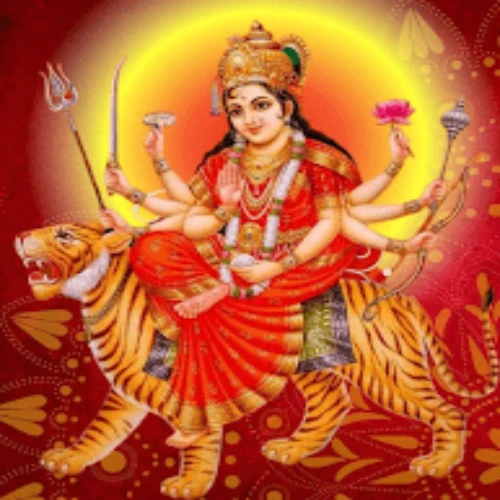
“Jai Jai Bhairavi Asur Bhayauni” is a renowned Maithili hymn dedicated to praising the power and valor of Goddess Bhagvati. The hymn describes the fierce and potent form of Mother Bhairavi, who is revered as the dispeller of fear caused by demons and malevolent forces.
In this verse, the Mother is addressed as Pashupati Bhamini—that is, as the divine consort and power of Lord Shiva. The poet prays to Goddess Bhagvati for the grace of innate wisdom, righteous intellect, and the privilege of remaining under Her divine shelter.
This celebrated hymn is associated with the devotional poetic tradition of Vidyapati. Its language beautifully harmonizes the melodic sweetness of Maithili with the fierce nature of the Goddess.
Recitation of “Jai Jai Bhairavi Asur Bhayauni”
jay jai bhairavi asur bhayauni,
jay jai bhairavi asur bhayauni,
pashupati bhamini maya.
sahaj sumati var diyau gosowni,
sahaj sumati var diyau gosowni,
anugti gati tua paya.
jay jai bhairavi asur bhayauni.
vasar rain sabasan shobhit,
vasar rain sabasan shobhit,
charan chandramani chuda.
kataok daitya maari mukh melll,
kataok daitya maari mukh melll,
katao ugili kl kuda.
jay jai bhairavi asur bhayauni.
samar baran nayan anuranjit,
samar baran nayan anuranjit,
jald jog fulkoka.
kat cut vikat oath put pandari,
kat cut vikat oath put pandari,
lidhur fen uth fonka.
jay jai bhairavi asur bhayauni.
ghan ghan ghanay ghunghru kat bajay,
ghan ghan ghanay ghunghru kat bajay,
han han kar tua kaata.
vidyapati kavi tua pad sevak,
vidyapati kavi tua pad sevak,
putra bisru jani mata.
jay jai bhairavi asur bhayauni.
jay jai bhairavi asur bhayavni.
jay jai bhairavi asur bhayavni.
jay jai bhairavi asur bhayauni.
Note: Variations in the spelling or pronunciation of certain words may be found across different renditions and publications of this Maithili verse.
Meaning of "Jai Jai Bhairavi Asura Bhayauni"
In this hymn, the poet describes the fierce, powerful, and protective form of Mother Bhairavi. The Mother is invoked as the power that strikes terror into the hearts of demons and evil forces while simultaneously protecting her devotees.
“Jai Jai Bhairavi Asura Bhayauni”
The essence of this line is—Hail to You, O Mother Bhairavi! You are the one who instills fear in demons and evil forces.
“Pashupati Bhamini Maya”
The Mother is addressed as the consort and power of Lord Pashupati (Lord Shiva). Here, the Goddess is revered as Shiva's divine energy and as *Maya* (the cosmic illusion/creative power).
“Sahaja Sumati Vara Diyau Gosauni”
The poet prays to the Mother, saying, "O Mother! Grant me the boon of a naturally pure and wise intellect."
“Anugati Gati Tua Paya”
In this line, the devotee expresses the desire to seek refuge at the Mother's feet and to follow the path shown by Her.
Description of Mother Bhairavi’s Form
The subsequent part of the verse describes the magnificent and fierce form of Mother Bhairavi. It depicts the beauty of ornaments resembling moonstones adorning Her feet and portrays Her act of destroying demons.
This description can be seen as a symbol of the Goddess's power and the destruction of evil forces.
Significance of the Goddess's Fierce Form
Lines such as "Samar Barana Nayana Anuranjita" offer a poetic portrayal of the Goddess's complexion, Her eyes, and Her profound presence.
Further on, the imagery shifts to the Goddess's formidable and martial aspect.Here, the Goddess appears not merely as a gentle mother, but as the Primordial Power (*Adi-Shakti*) who annihilates unrighteousness and demonic forces.
Description of Ankle Bells and Battle
The phrase “*Ghan ghan ghanay ghunghru kat bajay*” describes the resounding sound of the ankle bells adorning the Goddess's feet.
Simultaneously, lines such as “*Han han kar tua kaata*” evoke the heroic spirit of the Goddess engaged in battle and the destruction of evil forces.
Thus, the entire verse reflects the Goddess's heroic, fierce, and protective nature.
Vidyapati’s Prayer to the Mother
At the end of the verse, the poet identifies himself as a servant at the Goddess's feet:
“Vidyapati kavi tua pad sevak,
Putra bisaru jani mata.”
The essence of this is that the poet, regarding himself as the Mother's son and servant, prays that she never forgets him.
This line imbues the entire verse with deep emotion. After depicting the Goddess's fierce form, the poet ultimately seeks refuge in the Mother's maternal affection and grace.
Religious Significance of 'Jai Jai Bhairavi Asur Bhayauni'
This hymn is associated with the worship of the Goddess in her Shakti (divine energy) form. In it, Mother Bhairavi is invoked as the Goddess who dispels the fear of demons, destroys evil forces, and bestows wisdom upon her devotees.
Such devotional hymns dedicated to the Goddess hold a special place in Maithili devotional literature. The language of the hymn beautifully blends devotion, the sentiment of valor (*Veer Rasa*), and the tender bond of a child with a mother (*Matru-bhav*).
When to Recite 'Jai Jai Bhairavi Asur Bhayauni'?
Devotees may recite or sing this hymn according to their faith. It is particularly suitable for:
During Navaratri
On the occasion of Durga Puja
During the worship of Mother Bhairavi
During *Bhajan-Kirtan* (devotional singing) in a temple of the Goddess
During morning or evening prayers
At religious and cultural events
On occasions dedicated to the worship of Shakti
The Essence of the 'Jai Jai Bhairavi Asur Bhayauni' Hymn
The core essence of this hymn is not merely to describe the fierce form of the Goddess; it also reveals the profound bond shared between the devotee and the Mother.
The poet begins by describing the Mother's immense power and her destruction of demons, but concludes by identifying himself as her son and servant, pleading: "Oh Mother, do not forget your son."
It is this maternal bond that imbues the hymn with such deep devotion.
Worship of Mother Bhairavi
Mother Bhairavi is regarded as one of the fierce forms of Shakti. In the worship of the Goddess, devotees invoke Her through mantras, stotras, aartis, and bhajans, in accordance with their faith and traditions.
If an individual wishes to undertake a specific Tantric practice or ritual, it should be done only under the guidance of a qualified Guru or Acharya.
"Jai Jai Bhairavi Asur Bhayauni" – FAQ
What is "Jai Jai Bhairavi Asur Bhayauni"?
It is a renowned Maithili hymn (*stuti*) dedicated to Mother Bhairavi, describing Her fierce, powerful, and protective form.
Who wrote "Jai Jai Bhairavi Asur Bhayauni"?
This composition is famously associated with the poetic tradition of Vidyapati.
In which language is "Jai Jai Bhairavi Asur Bhayauni" written?
It is written in the Maithili language and holds special significance in Maithili devotional literature dedicated to the Goddess.
What is the meaning of "Jai Jai Bhairavi Asur Bhayauni"?
Its essence is "Victory to Mother Bhairavi," the Goddess who strikes fear into *asuras* (demons) and evil forces while protecting Her devotees.
When should "Jai Jai Bhairavi Asur Bhayauni" be recited?
It can be recited during Navaratri, Goddess worship ceremonies, *bhajan-kirtan* gatherings, or as part of one's daily worship, according to one's devotion.
Which Goddess is worshipped in this hymn?
This composition worships Mother Bhairavi—the fierce yet protective manifestation of Goddess Shakti.
"Jai Jai Bhairavi Asur Bhayauni" is a beautiful Maithili hymn that expresses Mother Bhairavi's power, valor, and maternal nature. It describes the destruction of demons by the Goddess's fierce form while also reflecting the simple, heartfelt prayer of a devotee.
In the concluding verses, the poet regards himself as a servant and son at the Mother's feet, praying for Her continued grace and blessings.
It is this devotion and maternal sentiment that make this verse special.Hail Mother Bhairavi.
Hail Mother Goddess.